Research guide: An Inerasable Embrace
What is this research guide?
NIVAL, through the National College of Art and Design, is a member of L’Internationale, which is a European confederation of thirteen museums, arts organizations and universities.
In the summer of 2026 and as part of L’Internationale’s core thematic thread of ‘The Past in the Present’, NIVAL and IMMA partnered on a researcher-in-residence project to look at the crucial roles our local and shared histories hold in constituting contemporary identities, politics, societies and cultures. The outcome of the project is a written research guide that reflects NIVAL’s and IMMA’s collections and activities.
The researcher in residence who undertook this work is artist Aisling-Ór Ní Aodha. Through the media of sound, text, painting, performance and radio broadcast, her practice interrogates the enactment of colonial ideologies and state institutions upon the body. This research is informed by archival investigation, queer and post-colonial theory and performance studies. Aisling’s resulting research guide, An Inerasable Embrace, has been designed to support critical inquiry, teaching and learning and creative expression that will guide researchers and facilitate greater access to the collections.
Introduction
The R115 is a winding mountain road through hills, lakes and expanses of peat-covered granite. It leads you out of the suburbs of Dublin and onto a leafy road where you embark on a series of sharp bends on a steep tree-lined ascent. The road is not isolated but a series of encounters – coasting behind a mini peloton, snaking along the treacherous bends in a chain of cars and slowing for the ambitious hikers who began their journey in the suburbs. Eventually this winding ascent levels out and the trees clear, delivering to all of us journeying this way a snapshot of a green valley with dark shades of the Featherbeds’ blanket bog and the black sheen of the Bohernabreena Reservoir and a distant pale blue view of Tallaght from the vantage point of the road. The view is almost perceptible before it is seen. For the view is framed by the road; by its widened edges for motorists to pull over, or the worn dead grass that is now an informal parking space, but in this case the giveaway was a parked ice cream truck nestled in a widened part of the road.
In 1916 the playwright Samuel Beckett “witnessed the 1916 Rising, including the sight of Dublin in flames, from the distance and safety of the Wicklow Mountains,” (Clare, 2016, p. 498) an experience he would later adapt into his novel Mercier and Camier where he describes the Military Road as:
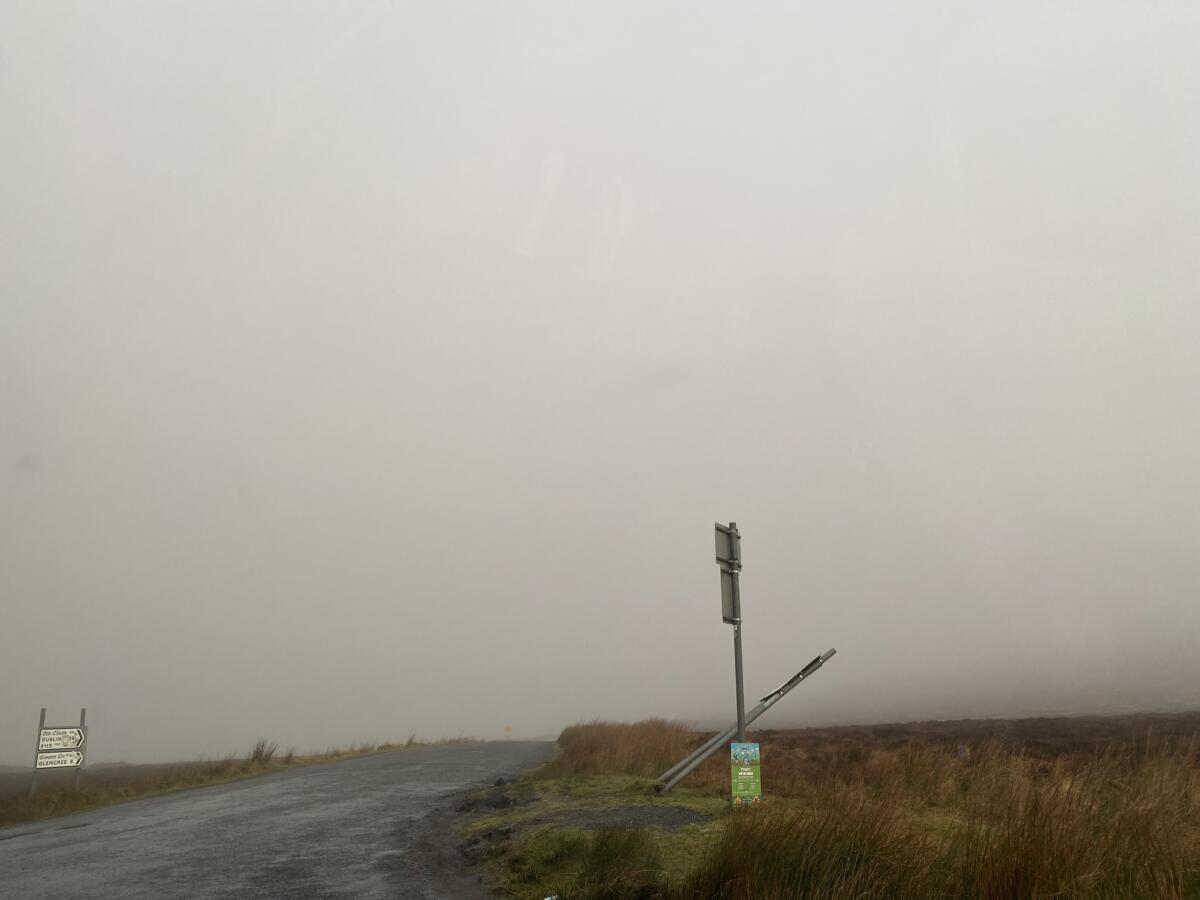
“A road still carriageable climbs over the high moorland. It cuts across vast turfbogs, a thousand feet above sea-level, two thousand if you prefer. It leads to nothing any more. A few ruined forts, a few ruined dwellings.” (Beckett, 1974, p. 97)
The Old Military Road (R115) became my occasional commute from Wicklow to Dublin city centre during a L’Internationale Research Residency. The brief required me to examine the archives and collections of the Irish Museum of Modern Art (IMMA) and items in the National Irish Visual Arts Library (NIVAL) under the theme of “The Past in the Present”, specifically colonial legacies in Ireland. The endurance of British colonial ideology in Ireland today manifests itself explicitly and subliminally in everyday life in Ireland. The line “it leads to nothing anymore” although vaguely alluding to the dilapidated architecture which is dotted across the periphery of the road, gains a new dimension when considering its original purpose as a colonial engineering project. The Old Military Road was born out of necessity following the 1798 United Irishmen uprising, the first non-sectarian republican rebellion, influenced by the Enlightenment and the French Revolution. The Wicklow mountains served as a strategic outpost for guerilla warfare, and following the failure of the rebellion, the British administration had designated it as a site that required policing. The road will cut through what the British army saw as the barbaric desolate landscape of the Wicklow Mountains, disarming the United Irishmen in Wicklow of their so far successful guerrilla warfare by striking a road right through the terrain that runs from Rathfarnham to Aughavannagh.
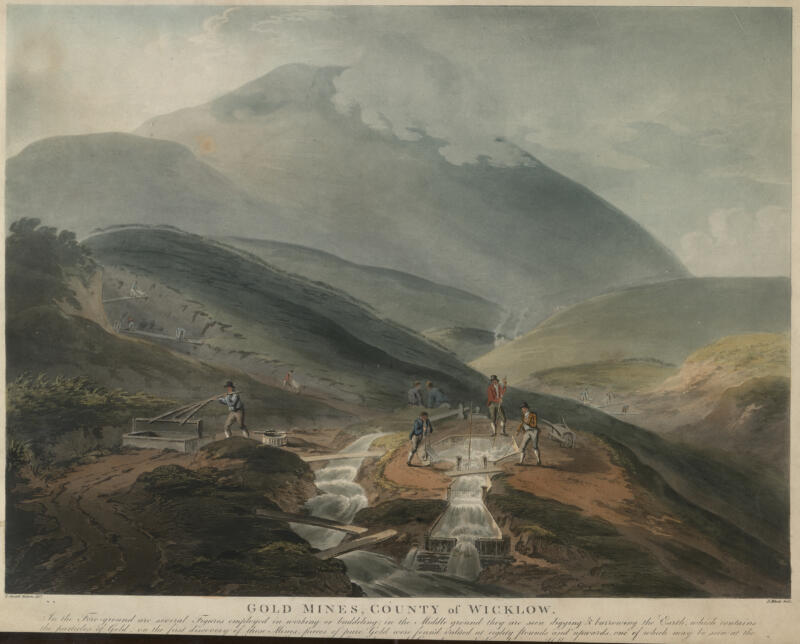
During the nine years (1800–09) it took to construct the road, a series of landscape paintings by Thomas Sautelle Roberts was created of the Wicklow mountains and the road during construction. It is believed the purpose of these paintings was to exhibit them in Dublin Castle, the headquarters of the British administration in Ireland at the time. The paintings are stylised, picturesque, generating a new view of the Wicklow mountains no longer associated with the republican rebels but are now tamed into a familiar beauty.
In Shannon Mattern’s text, Infrastructural Tourism, she explains the historic definition of infrastructure as being “the asphalt roadways and steel rails that were typically national (often military) initiatives”. (Mattern, 2013) This definition has expanded to include transportation, gas, water supply, electricity and within that the methods used to deliver these systems such as standards of measurement, ecological surveys and cartography. The Irish for Roundwood (a village just off of the Military Road) translates to “An Tóchar” or “a causeway that cuts through a bog”. It is significant to think of place names as that which defines the absence it has created into what has come before. The construction of a road might be defined as an addition to a place. It is adding accessibility, safety and adding the potential of a journey. But to consider it instead as another kind of negation creates a new relation with what it has been built upon. Road networks in a literal sense fit the historical definition of the word infrastructure as a system that is covert, the thing that was built underneath or before the “superstructure”. (Carse, 2017, p. 29)
Considering the painting The Gold Mines of County Wicklow by Thomas Sautelle Roberts, a painting made in tandem with the road’s completion, the correlation between the infrastructure created by the British occupation in Ireland and the superstructure of landscape painting in the nineteenth century are quite explicitly expressed: the physical suppression of the rebels was not sufficient, a cultural force was also required. Travelogues from the periods following the completion of the road are even more explicit in associating the road with the aim “to colonize the mountainous district, through which the road runs, with the hardy and industrious race who executed this great work.” (Wright, 1822, p. 125)
During this relatively brief commute, a simple strip of asphalt became an artery to the myriad of engineering projects, buildings and infrastructure which have been built under different purposes but are now sites that are supposedly reconciled, or at peace.
The grounds of the Irish Museum of Modern Art (IMMA) are an example of many former colonial architecture feats in Dublin City centre where the original military purpose has now been repurposed into cultural institutions such as Collin’s Barracks, The Chester Beatty Library and Dublin Castle. In Fintan Cullen’s introduction to Ireland and the British Empire: Essays on Art and Visuality (2023) he writes:
“While many of the pro-empire statuary that once dotted the streetscape of the city did indeed ‘collapse’ and have gone due to either violent destruction or official dictate, it is important to stress that, in Dublin and other Irish cities and towns, the built environments still possess the publicly accessible images of empire.”
(Cullen, 2023, p. 4)

And on the grounds of IMMA they possess both of these potential outcomes of public images of the British Empire. While the Royal Hospital Kilmainham remains standing, preserved and often admired as a piece of historical architecture for British army veterans, on the overlooking green to the nearby formal gardens of IMMA are large fragments from the monument to Queen Victoria. This was once stored at Leinster House before she was removed in 1948, where she and the figures of her plinth were temporarily kept in the courtyard of IMMA arranged, as Lisa Moran describes, “on a wooden structure that created the strange impression they were setting off on an excursion with Victoria at the helm.” (Moran, 2020) While Victoria’s statue was eventually sent to her final home of Sydney, Australia, fragments of her plinth remain.
In the reading rooms of the National Irish Visual Art Library (NIVAL), in the National College of Art and Design (NCAD), a plaster bust of the executed leader of the 1916 Easter Rising Joseph Plunkett by Peter Grant, 1958, stares over the heads of the quiet visitors who bow over the artists’ ephemera they are researching. With three final bronze versions in the collections of Dáil Éireann, the National Gallery of Ireland and Belvedere College, the plaster bust now sits slightly unmoored in the quiet of the reading room. He sits in a room alone, while across the road in John’s Lane, a building bearing the name of the cartoonist, republican and his brief wife, Grace Gifford hovers similarly unmoored. Yet once attention is drawn to such evocative history, an experience across the Irish landscape is recognisable: remnants of a colonial past appearing like a distorted image under water, you have the choice to muddy it and preserve its affective mystery, or dive in. This may be more accurately defined as a responsibility to know and act within a historical reality. In Robbie McVeigh and Bill Rolston’s 2021 book, Anois ar theacht an tSamhraidh: Ireland, Colonialism and the Unfinished Revolution, they begin their methodological description as follows:

“We start from the position that the world is knowable. History matters; and, for all its complexity, it can be read. On the one hand history is continuously reinterpreted. On the other, history happened, and this provides a kind of Cartesian platform for analysis. History of course can be revised – and even distorted and denied – but it cannot be undone.”
(McVeigh and Rolston, 2021, p. 10)
In order to be politically active in the present, the past must be knowable and continuously reacquainted with. In Ireland, to put the past to rest in order to have a consensus of national history has yet to be arrived at for those oppressed by colonial and racialised histories, where lives and stories are erased through commodity and subjection, where an unwritten past creates an unmoored present. As the American writer Saidaya Hartman writes: “Every historian of the multitude, the dispossessed, the subaltern, and the enslaved is forced to grapple with the power and authority of the archive and the limits it sets on what can be known, whose perspective matters, and who is endowed with the gravity and authority of historical actor.” (Hartman, p. 7) The binary of past and present within protracted colonial contexts such as Ireland are not definitions easily applied when much of Irish political life remains unresolved and fragmented. In order to remain within this fragmented history, in what Fredric Jameson describes as “periodisation”, this guide is operating under the Benedict Anderson quote “An Inerasable Embrace”. In Imagined Communities Anderson lays out the basis that censuses, mapping and museums come from the quantifying and surveying of land, subsequently resulting in the creation of a subject that is now countable: “… which by its emptiness, contextualness, visual memorableness, and infinite reproducibility in every direction brought census and map, warp and woof, into an inerasable embrace.” (Anderson, 2006, p.185) Defining the institutional remains of colonialism as an “embrace” is an attempt to account for the often-indefinable experiences of dissonance between creative expression, institutional dissemination and the artistic attempts to account for Irish political life throughout the 20th and 21st century – or deliberately reject the imperative to do so.
The attempt to break the shackles of the Irish past is a tempting impulse. To reject the suffering, the hunger, the silences, the familial breaks, the war crimes, the martyrdom in favour of a present full of new potentials. On the grounds of IMMA today this impulse is visible to any visitor. Situated above the formal gardens lies the symbolic remains of Patrick Ireland, one of the alter egos of the Irish artist Brian O’Doherty, who performed a funeral for him in 2008 which is now memorialised by a stone plaque artwork titled The Burial of Patrick Ireland. When British paratroopers opened fire on a peaceful civil rights demonstration in Derry, 1972, thirteen people, including a child, were murdered in an act of violence which became a galvanising point for many Irish people to be enlivened once more to British colonial violence and subsequently British so-called justice. Out of this atrocity Patrick Ireland was born, a political statement by Brian O’Doherty, vowing to sign all works in this name as an act of protest until British presence is removed from the north of Ireland.
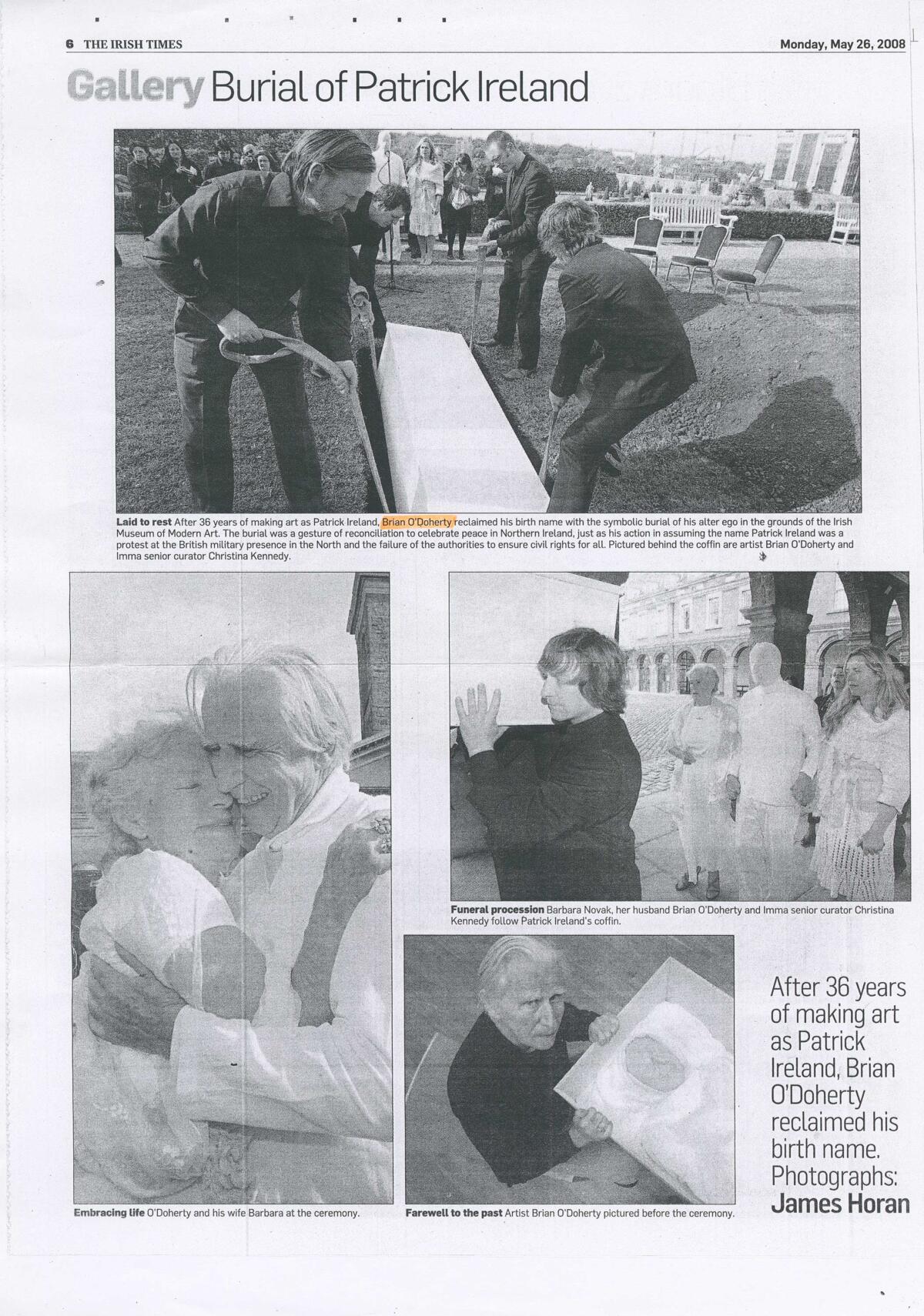
Thirty-six years later, a small crowd would jubilantly mourn the death of Patrick Ireland on the grounds of IMMA. A grave was dug, Alannah O’Kelly performed a caoineadh and poems were read. As Jennifer Higgie wrote for Frieze Magazine: “Ireland concluded his life by pulling the mask off his face and throwing it exuberantly into the grave, along with a handful of dirt. ‘We are burying hate,’ he declared, ‘and it’s not often you get the chance to do that.’” (Higgie, 2008) To the familiar, culturally affirming melodies of Irish traditional music, O’Doherty proclaims an end to hate, a response to the subsequent years of political remission following the signing of the Good Friday Agreement in 1998. The finitude embedded within O’Doherty’s performance can be read as a desire to bury the past, in order for a latent Irish history to take shape and maintain this agreed form indefinitely.
Yet at the time of Patrick Ireland’s burial the public inquiry into the actions of the paratroopers on Bloody Sunday were still underway, with a public apology and acknowledgement that the victims were indeed unarmed at the time of their murder only taking place in 2010. In 2025, the paratrooper known as Soldier F who shot James Wray and William McKinney on that cold January day was tried in Belfast Crown Court for their murder and five counts of attempted murder. He was found not guilty. At the time of writing, family members of the victims of Bloody Sunday are still campaigning for justice for their loved ones. They receive hate mail regularly for their actions. The resting place of Patrick Ireland, under the broken vestiges of stone carvings that once buffeted the monument to Queen Victoria, has only become an unquiet grave since his burial. The peaceful stone plaque which pronounced the death of Patrick Ireland is far more akin to the desire for a historical punctuation mark than a true end to Ireland’s past as a colony of Britain. As McVeigh and Rolston write: “But if history is taken in the simplest sense as an account of the past, that is, of something that is over, then in a sense Ireland does not have a history. Rather, it has an ongoing experience, albeit periodised, whereby the past is not yet over.” (McVeigh and Rolston, 2021, p. 8) Patrick Ireland belligerently rests in peace.
Ireland’s cultural institutions are populated with symbolic gestures and contextless objects which refer to colonial legacies but rarely provide direct statements or answers on how they got there or what their meaning is now in contemporary Irish life. As outlined at the beginning of this text, it is arguably from the 1798 rebellion that the recognisable form of a cultural superstructure developed to the underside of colonial violence and subjugation in Ireland. In recent years the desire to portray Irish colonial history, specifically Irish republicanism, through ironic displays of merchandise or trivialisation of political actions and statements has come to define a new strain of historical awareness in the 2020s. Tricolour balaclavas, petrol bomb artwork and comical video interviews asking the question ‘would you die for Ireland?’ become indicative of what Jameson describes as a “cultural form of image addiction” (Jameson, 1984, p. 85) which transforms past imagery in Irish history, of political martyrdom and sacrifice in the face of colonial terror into a series of ineffectual pantomimes. Jameson continues: “… which, by transforming the past visual mirages, stereotypes or texts, effectively abolishes any practical sense of the future and of the collective project, thereby abandoning the thinking of future change to fantasies of sheer catastrophe and inexplicable cataclysm.” (Jameson,1984, p. 85) In the face of an ongoing genocide in Palestine, rising fascism and threats of inter-imperialist war, many may flinch from what the future holds. Present inaction to such terrors may be alleviated by trivialising previous acts of resistance, but the result is a rejection of a future. And so rather than passively accepting the assessment of an end to history and therefore no future progress being in sight, it is more accurate to claim that no one wants to live in the future that awaits us if the acceleration of imperialism continues to rule the present.
It is from this temporal reality and assessment of the Past in the Present that this research guide into the collections and archives of IMMA and NIVAL hopes to position itself. Taking McVeigh’s and Rolston’s definition of Ireland being of periodised experiences, Fredric Jameson’s analysis of the cultural superstructure of postmodernism and the modern formation of national identity by Benedict Anderson, the artwork, artists’ ephemera and designs examined in this guide will be treated as such examples of periodisation. As moments of experience in Irish cultural life which are part of the economic superstructure of the last hundred years of colonised and semi-colonised Irish life. The guide will be structured across four headings: ‘The Landscape, Picturing Painting and the Picturesque’, ‘Let This Moment Linger: The Promise of 1916’, ‘Pronouncing Silence’ and ‘Irish Republicanism and the Past in Irish Contemporary Art’. These attempts at art historical analysis are grounded in their historical reality, and that history cannot be undone, but certainly known. Sometimes through art.
Let This Moment Linger: The Promise of 1916
The definition of an Irish national identity through cultural expression had never reached such levels of activity and output until the late nineteenth and early twentieth century due to specific developments in understandings of the public dissemination of art, crafts and technological developments. Arguably, the formation of what are now recognisably modern institutions of cultural dissemination such as the museum and public libraries generated a desire to begin to interpret a locally specific, colloquial culture into a national identity; to generate the folklore and oral traditions of Ireland into what Diarmuid Ó Giolláin has described as the oxymoron of a “vernacular literature” (Ó Giolláin, 2013, p. 82). Such desire was also emerging concurrently with increasingly organised armed resistance against British occupation in Ireland through the nineteenth century. The following section will examine the development of an Irish national identity in the lead up the 1916 Easter Rising as a result of a dialectical relationship between the British cultural institutions established in Ireland under the Act of Union and the heightened political organising within the Irish republican movement. This relationship resulted in the synthesis of a new cultural national identity which artists and activists such as Grace Gifford, Cesca Trench, Maud Gonne and Ella Young contributed to whilst being active member in the cause for Irish independence in the early twentieth century.
In 1850, the Public Libraries Act of 1850-53 was established in Britain. This act would see the initiation of public libraries, which would be associated with a liberal democratic citizenship and a moralistic responsibility towards public education and wellbeing. This Act would affect the metropolitan centre of the empire and its colonies such as Ireland, which had been incorporated into the Act of Union of 1800-01, establishing public and subscription-based libraries as a method of “democratizing knowledge” and to improve education amongst “common readers”. Rooted in the principles of self-improvement, rational recreation and utilitarian thought that underpinned nineteenth-century liberalism, the public library was introduced as a legal entity in Britain and Ireland by the Public Libraries Acts of 1850 and 1853, and the establishment of state-supported free public libraries in the southern colonies was closely associated with this new emblem of “liberal, democratic citizenship”. (Atkins et al., 2019, p. 18)
Similarly, the Public Libraries Act coincided with the Great Exhibition of 1851, a lavish display of British industry and colonial pillaging held in Hyde Park, London. The exhibition aimed to emphasise Britain’s technological advancements and their colonial might by displaying luxury resources extracted from colonies such as India, the Caribbean and others: “The Great Exhibition, therefore, structured a space of interaction between the European metropole and colonial periphery.” (Grey, 2023)
In 1855, the Public Libraries Act was extended to Ireland. Similarly in Ireland, the enactment of the Public Library Act of 1855 was preceded by the Great Dublin Exhibition in 1853, mirroring the same exhibition held in Britain two years previously, showcasing Irish industry alongside fine art and crafts exhibits. The exhibition was almost entirely funded by the engineer William Dargan, who was responsible for extending railway lines throughout Ireland.

Exhibitions of art and industry were approved by the Department of Science and Art as a means of public art education. Current production could be compared, evaluated and measured against the best examples of the fine and applied arts of the past, through ‘loan museums’. The Irish exhibitions of arts and industries reflect this ‘Science and Art’ thinking. Terence de Vere White has written, “an international exhibition happily combined the characteristics of a Roman triumph and a Sunday School treat. It emphasised the commercial triumphs of empire and at the same time improved and expanded the mind.” (Turpin,1981, p.3) More libraries were built in Ireland in coming years, the National Library being founded by the Dublin Science and Art Museum Act of 1877, and the aftermath of the Dublin exhibition would result in the founding of the National Gallery of Ireland in 1864.
The significance of outlining this history of libraries, museums and fine art in the modern era is to detail how the impulse to democratize knowledge in this period is closely aligned to industrial developments as a result of capitalism and imperialist expansion. How contemporary institutions that disseminate knowledge in art – art libraries/art galleries – are situated within this historical lineage is important for interrogating how a user/visitor of a library/gallery is expected to engage with art and the print culture surrounding it.
If the origins of modern knowledge dissemination coincide with wealth and industry based upon capitalist and imperialist exploitation, then the subject they wish to address is already accepted as being encircled into this embrace of knowledge but wholly on the terms of not questioning the necessary subjugation to maintain these institutions of learning.
Libraries and museums under British rule during the height of their empire come to symbolise imperial epistemological expansion. The grand architecture devoted to libraries and museums in London and Dublin are monuments to knowledge generated or objects amassed through colonial pillaging and developing an ideology around racial supremacy. As Turpin wrote, the great exhibition was not just about gathering objects to show geographical expansion, but they represented the mind under imperialism taking shape. If we understand libraries and museums in this historical context, their architectural presence in metropolitan centres of empire can be seen to represent the imperial brain.
In the case of the British colonial administration in Ireland, following the mass erasure of members of the indigenous population in Ireland during an Górta Mór (who would be characterised as monolingual Irish speakers), the introduction of the Public Library Act to provide education to the colonial subject comes after a significant number of the non-English speaking population have been murdered or forcibly displaced. It is after slaughter, when the colonizer surveys, quantifies and assesses the land they have exploited and conquered, that what Benedict Anderson calls “an inerasable embrace” occurs:
“Interlinked with one another, then, the census, the map and the museum illuminate the late colonial state’s style of thinking about its domain. The ‘warp’ of this thinking was a totalizing classificatory grid, which could be applied with an endless flexibility to anything under the state’s real or contemplated control: peoples, regions, religions, languages, products, monuments, and so forth. The effect of the grid was always to be able to say of anything that it was this, not that; it belonged here, not there. It was bounded, determinate, and therefore – in principle – countable.” (Anderson, 2006, p. 184)
It is in this historical context of Irish cultural institutions beginning to formulate that the cultural revival periods of the late nineteenth and early twentieth century might be understood as the attempt to imagine the victory of a national liberatory revolution before this material reality was met: a mirage of a future superstructure of a free Ireland in the face of the British Empire at its cultural and military height. As Marie O’Neill wrote, the formation of The Gaelic League in 1893 by Douglas de Híde and Eoin MacNeill, Inghinidhe na hÉireann in 1900 led by Maud Gonne and the founding of the Irish Literary Theatre by Augusta Lady Gregory and William Butler Yeats are just a few examples of how the Irish cultural life that is familiar to many today began to take shape during heightened republican organising in at the turn of the century in Ireland. (O’Neill, 2000)
Familiar Faces Grace Gifford
In the National Visual Arts Library, a small collection of ephemera and material from the artist, caricaturist and republican Grace Gifford are preserved. Born in 1888 in the affluent area of Rathmines to Frederick and Isabella Gifford, she was the second youngest of twelve children. In 1904, at the age of sixteen she enrolled in the Dublin Metropolitan School of Art where her aptitude for caricature and drawing flourished. She studied under the tutelage of the Irish painter William Orpen, which developed into a warm bond, reflected in his 1907 portrait of her titled Young Ireland: a portrait which reflects what Marie O’Neill described as her humorous personality. (O’Neill, 2000, p. 6) This trait is palpable in her suppressed smiling mouth in the portrait and further emphasised in an early illustrative work by the young artist titled Familiar Faces. The booklet is a testament to Grace Gifford’s early years at the Dublin Metropolitan School of Art, where she experimented with text and caricature in order to narrativize her experience with her tutors.
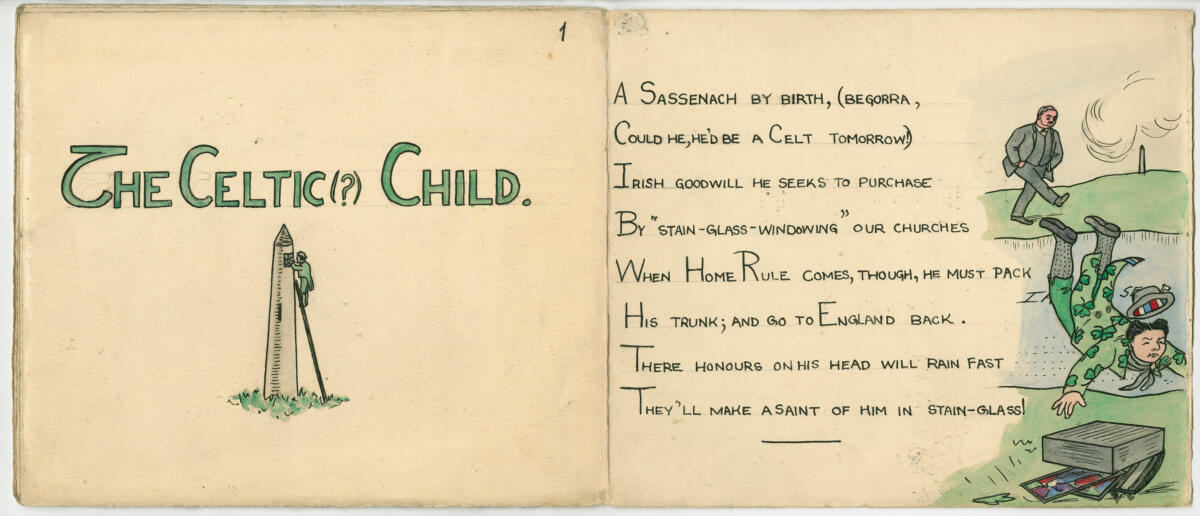
One sketch titled “The Celtic(?) Child” demonstrates not only her wit through rhyme but her early nationalist tendencies. Writing about the English tutor of stained glass, Alfred E. Child, her satire opens with Child scaling a round tower, referring to his management of the stained glass cooperative An Túr Gloine. She writes “A Sassenach by birth, (Begorra, / could he, he’d be a Celt Tomorrow!) / Irish goodwill he seeks to purchase / by ‘stain-glass-windowing’ our churches.” Her sketch depicts Child dressed in a suit and coattails emblazoned with shamrocks, yet beneath the hat he wears the colours of the Union Jack. Gifford’s lampooning of Child, asserting that once ‘Home Rule’ is achieved Child will return to England, demonstrates a rising tension in Irish political and cultural life that found its roots in the mid-nineteenth century. Gifford came from a strong Unionist family, although she and three and her sisters would develop their politics in support of Irish republicanism. Although she is now primarily associated as the ill-fated bride of the republican and one of the signatories of the 1916 Proclamation Joseph Plunkett this early work proves her political beliefs were developing independently in her teenage years. As Christian Dupont wrote: “She was, or rather became, an activist and artist in her own right,” (Dupont, 2018, p. 58) – a historical fact perhaps easily forgotten or obscured by the now famous ballad by Frank and Seán O’Meara, ‘Grace’, where Joseph Plunkett is imagined to have addressed Grace Gifford the night before his execution:
“Now, I know it’s hard for you, my love, to ever understand,
The love I bear for these brave men, my love for this Dear land.”
On the contrary, Grace Gifford’s perspective seems indicative of a wider movement amongst young women artists who were inspired by the new artists’ movement and the political momentum of figures such as Constance Markievicz and Maud Gonne. Fellow artists and poets such as Estella Solomon, Ella Young and Cesca Trench were members of Cumann na mBan and were active during the revolutionary period before and after the 1916 Easter Rising. As Hilary Pyle writes of Gifford’s own developing commitment to national liberation, it was primarily through the lens of being an artist where her commitment found strength: “She supported Countess Markievicz in humanitarian activities and protests, she joined the Irishwomen’s Franchise League and Sinn Féin, but she did not join the Irish Citizen Army as her older sister Nellie did, and literature and theatre were her passions rather than politics.” (Pyle, 2014, p. 115) Perhaps Pyle, the author of Cesca’s Diary, 1913 -16: Where Art and Nationalism Meet, is keen to emphasise a difference in Gifford’s own political commitments in comparison to Cesca Trench who fought alongside Markievicz at Saint Stephen’s Green during the Rising.
The commitment to national liberation seen in such women as Gifford, Young, Trench and Solomon is indicative of the foundational clause of Irish Republicanism since the 1798 rebellion. The movement was no longer being dictated by the sectarian concerns of a Catholic king but rather by a commitment to a sovereign Ireland in a civic society. Trench, a British-born Irish nationalist, is just one example of many young people from unionist backgrounds shifting to the cause of Irish republicanism. Such shifts in allegiances and the differences of opinion between the developing cultural and militant groups were documented in the diary entries of Cesca Trench. As entry from Trench’s diary, dated 10 August 1914, reads:
“There was a meeting the other day, where Mac Giolla Bhríghde and Úna Ní Fhairceallaigh were speaking and saying that ‘England’s difficulty was Ireland’s difficulty, and any man who said other was a fool.’ She is too certain, I think, and have my doubts about her. She is Catholic, and under the thumb of the Church, I’ll never confide in her.” (Chenevix Trench and Pyle, 2005, p. 125)
Similar to Gifford’s depiction of Child, this diary entry is among many sentiments which illustrate the varying loyalties being deciphered depending upon the background of participants in the Irish freedom struggle at the time, and is a testament to a shift in Irish societal relations. From the British-Irish nationalist, the republican Protestant, the socialist aristocrat and the unionist Gaelic League members, the cause for Irish freedom was composed of many burgeoning allegiances of the time which frequently put into contrast the Irish Cultural Renaissance and the material, militant efforts to overthrow the British occupational forces in Ireland.
This included the desire of poets such as W.B. Yeats to collect and publicise the folklore and vernacular literature of Ireland, in what he saw as the pure traditions of a population unpolluted by the industrial revolution. However, as Nicola Gordon Bowe writes, the knowledge of Irish folkloric tradition had been decimated predominantly by the rise of folklore studies in the mid-nineteenth century. Therefore “the roots of the culture and identity she sought to establish and the growing spirit of national consciousness were given substance by archaeological, philological and antiquarian research from the 1840s on.” (Gordon Bowe, 2024, p. 25)
As was outlined in the introduction to Anderson’s descriptive term of “an inerasable embrace”, this relates to the burgeoning fields of antiquarianism, archaeology and folklore which would begin to fill the halls of museums. Anthologies of vernacular interpretations, created due to colonial violence such as an Górta Mór which destroyed the oral traditions, were also the creation of the vernacular’s museumification. As Diarmuid O’Giolláin writes, folklore began as it was disappearing. The mirage of a vulnerable, but idealised Irish society became the perfect wellspring for defining a national character.
The rootedness of vernacular traditions made them important in modern societies characterised by flux. They bestowed an authenticity and an antiquity that were used to root newer and larger collectivities at a time when traditional collective identities were crumbling. Crucially, they represented a collective value as modern society became more individualised. As traditions peculiar to the great mass of the people, but often not shared by the elite, they became resources for the development of new democratic political movements. (O’Giolláin, 2013, p. 83)
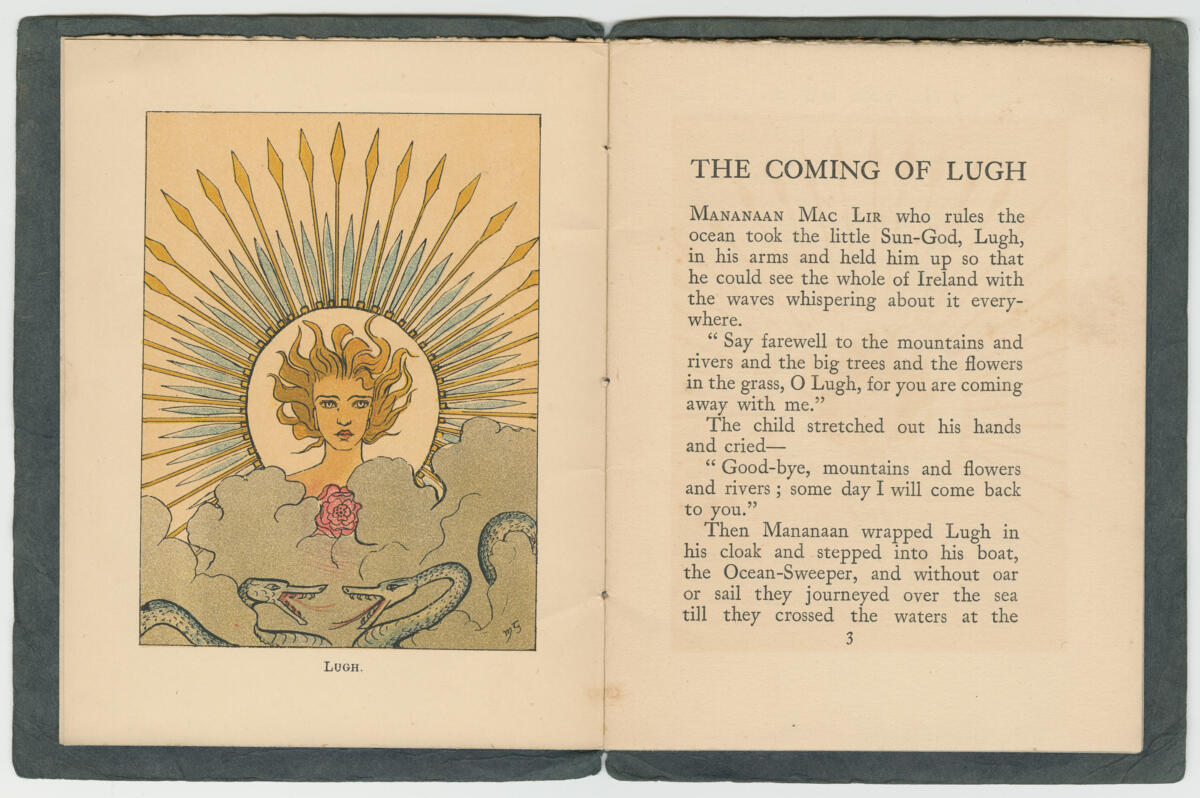
Although the enthusiasm for a pure Celtic culture of heroism and national strength was generated through new reinterpretations of Celtic mythology and folklore, such as The Coming of Lugh by Ella Young and illustrated by Maud Gonne, the limits of leading solely through cultural revolution must have been apparent to arts practitioners. As the biographer of Ella Young, Rose Murphy, writes, “[Young’s] involvement in Celtic literature and oral stories progressed from a love of Ireland’s culture to her sense that it was vital to throw off the rule of a coloniser who threatened that culture.” (Murphy, 2008, p. 61) The socialist republican James Connolly was additionally wary of the Irish peasant class being idealised out of their wretched, oppressed contexts of capitalist and colonial rule. In his 1898 text, The Language Movement, he warns:
“You cannot teach starving men Gaelic; and the treasury of our national literature will and must remain lost forever to the poor wage-slaves who are contented by our system of society to toil from early morning to late at night for a mere starvation wage.” (Connolly, 1898)
The dawn of Irish national liberation that Connolly and the rest of the leadership hoped for following the 1916 Easter Rising was not realised. Connolly, Gifford’s fiancé Joseph Plunkett and fifteen other leaders of the rising would be arrested and executed in Kilmainham Gaol.
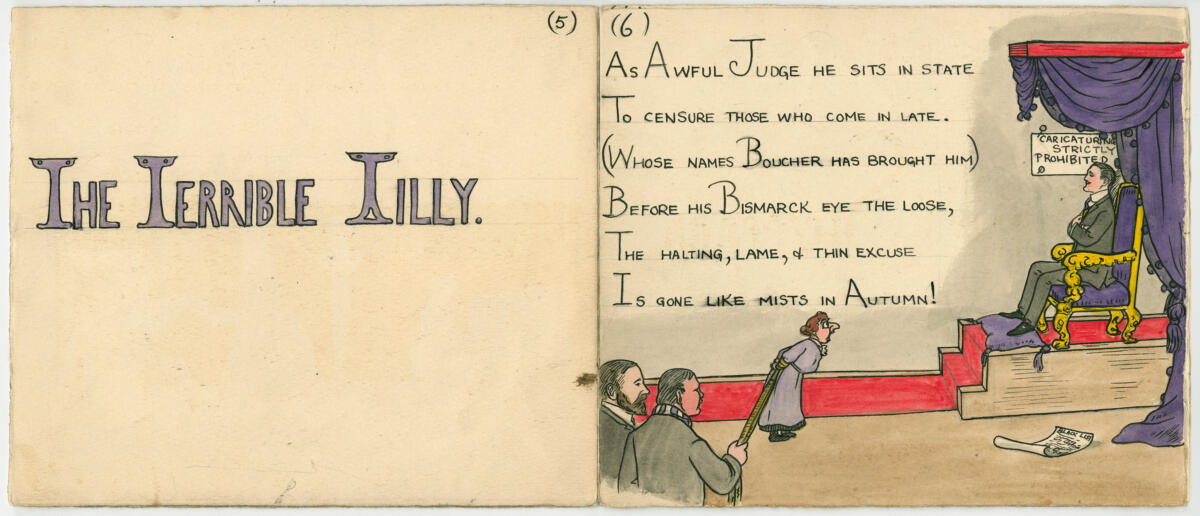
The NIVAL box on Grace Gifford contains one archival fragment which speaks to the nexus of worlds her life comprised: a small leaflet Dublin Travel Pass issued to a Mrs F. Tilly and child, dated 10 May 1916. The British authorities made travel passes such as these a necessary requirement for civilians following the suppression of the rebellion in order to prevent any further reorganising and movement. Mrs Florence Tilly was the wife of Benjamin I. Tilly, the registrar of the Dublin Metropolitan School of Art from 1907-22, a member of staff who Gifford also included in her Familiar Faces booklet under the title ‘The Terrible Tilly’.

By 10 May when the Dublin Travel Pass had been issued to Mrs Florence Tilly, Joseph Plunkett and the majority of the Easter Rising leadership had been executed, with James Connolly and Seán MacDiarmada being the final leaders executed on 12 May. Gifford and the majority of women who were members of Cumann na mBan and the Irish Citizen Army would be anti-Treaty activists during the Civil War with many being imprisoned in Kilmainham Gaol in 1923: a testament to the commitment many women had to not only national liberation but a socialist Ireland. It was during her incarceration here (her cell labelled under the title ‘Mrs Joseph Plunkett’s cell’ in the Gaol today) where she painted her mural of a Madonna and Child. Her caricatures and political cartoons contributed greatly to nationalist propaganda of the period.
1913 Lockout Tapestry Project
I would like to end this section on an item found in NIVAL’s special collections. In 2013, a commemorative tapestry in honour of the 1913 Lockout was commissioned by SIPTU and the National College of Art and Design. The tapestry was designed by the artists Robert Ballagh and Cathy Henderson and executed collaboratively across Dublin city. In the NIVAL box of the 1913 Lockout Tapestry Project, there is a wide variety of preparatory sketches, colour-swatching and communications to coordinate this ambitious project.
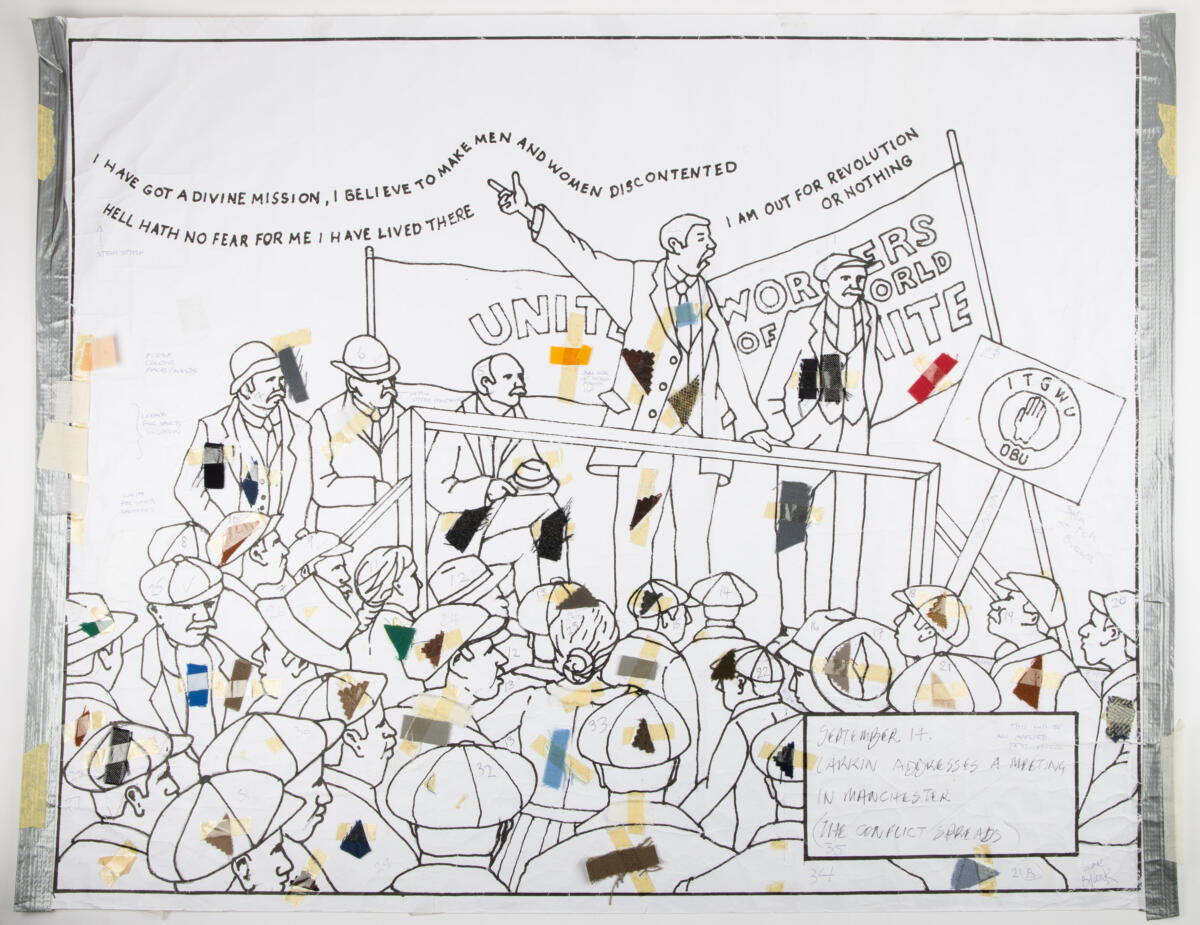
The collaborative nature of the tapestry’s process was a deliberate attempt to shift a relationship to Ireland’s past that is proactive rather than passive. “… the approach adopted is a participative one that involves people in reclaiming and understanding their own past rather than passively accepting the authorised version handed down by academics, politicians, the commercial media and powerful established interests.” (McNamara, 2013, p. 9)
The 1913 Lockout was the first powerful manifestation of organised industrial action against capitalist exploitation in Ireland, highlighting a new political development in Irish national liberation of socialist republicanism held by James Connolly, Constance Markievicz and the majority of the members of the Irish Citizen Army. The latter was first formed to defend the picket lines of the Irish Transport and General Workers’ Union. The men, women and gender-oppressed of Ireland at this time – many from diverse backgrounds or not Irish-born – were galvanised by this new political ideology of not only national liberation from the British Empire, but a new hope for gender equality, and an end to capitalist enslavement. Over 110 years later, the Ireland of today is facing a new terrifying reckoning with what it means to relinquish the past as an a priori series of events. As far-right political groups and fascists have attempted to take ownership of terms such as the ‘Irish Citizen Army’ (more than likely unaware of its socialist politics), it is more important than ever to know Irish – and by extension global – colonial history.
The preparatory sketch depicts Jim Larkin, the trade unionist, addressing a crowd in Manchester as part of the Irish Transport and General Workers’ Union (ITGWU). The line drawing is speckled with little swatches of colour taped on with masking tape, experimenting with the best fabric and colours to use to illustrate history. This section has attempted to demonstrate the history of the late stage of the British colonial state, consisting of a cultural regeneration in Ireland during the nineteenth century which had a dialectical relationship with the growing militant, anti-colonial movements of Irish Nationalism, synthesising into not only a cultural revival of the Celtic Twilight and the Gaelic League but more importantly an adoption of socialist politics as part of Irish liberation.
As Connolly argued, the cause for economic sovereignty cannot be fought through leading with cultural revivals, which did not prove to be immune to the rising force of fascism in subsequent years. On the contrary, the cultural revival lent itself to the aestheticization of politics, exemplified in figures such as Maud Gonne and W.B. Yeats. Walter Benjamin dissects fascism’s ability to inspire an irrational devotion to an idea – such as mysticism or the occult – and diagnoses it as a “violation” of mass organising, a perversion of the potential of workers to unite and organise against capitalist exploitation. Fascism does this simply by cultivating an affective sphere of unity through spectacle, racial laws, strict gender codes and militarism whilst maintaining the same power structures which exploit the worker at every turn. It is precisely the vapid display of aesthetic spectacle that concerns Benjamin, simply because fascism takes pleasure in humanity becoming disassociated from its material reality, powerless to the mechanism that exploits them. (Benjamin, 2008) In a world where A.I. art has become the visual language of fascism, the acceleration of a cynicism to human existence and creativity has increasingly haunted any affirmative efforts to act. As Fredric Jameson writes, frequently the postmodern condition may paralyse the impulse to act, feeling any action is foregone amidst the totalising systems of surveillance and modern warfare. The inspiration artists such as Grace Gifford found came from drawing upon the present material conditions of her time. This was a synthesis of political action and creative expression which allowed for a radical alternative to be glimpsed in one of the most defining events in modern Irish history. Whilst the cultural revivals discussed in this text came from a myriad of influences, they were ultimately limited in their ability to define national sovereignty due to ambiguities in political ideologies and commitments. If fascism’s aim is to enforce a disassociation from material reality, and stir support through affective imagery, it is the role of the artists to not resign themselves to an enclave of political immunity and sanctity.
The Landscape, Picturing Painting and the Picturesque
Two square, white canvases are flush next to each other. In each of the top left corners are miniature inserts of landscape paintings. A reflective lake. Trees in summertime. A blue sky. Untitled (1976) is part of a series of paintings by the conceptual artist Michael Craig-Martin, which included found paintings of amateur artists’ paintings he purchased in charity shops, sometimes depicting still lifes, other times landscapes.
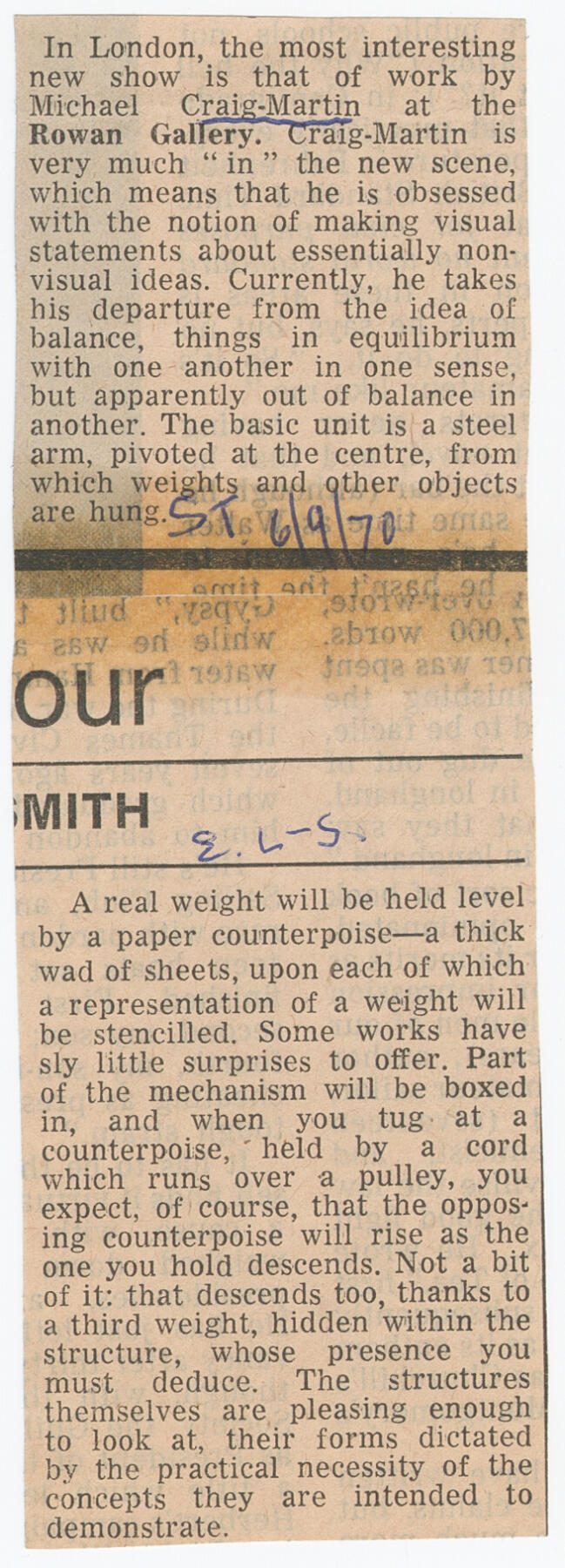
These would come to inform his 1978 series titled ‘Painting and Picturing’. The picturing painting series is an example of Craig-Martin’s earlier minimalist work before his trademark boldly coloured paintings for which he is now known. These are nonetheless foundational in his conceptual commitment to, as one article from the 1970s writes, “… the notion of making visual statements about non-visual ideas”. (Sunday Times, 1970)
The non-visual ideas could be described as what the art theorist Isabelle Graw would call the “success media of painting”. (Graw, 2018) The appropriation of another amateur artist’s landscape painting in the work situates the form of the ready-made in a tension with some of art history’s more formulaic art forms. Painted in what resembles the nineteenth-century European picturesque theory style, the small inserts operate similarly to mirages in the blank expanse of the white canvas, a shadow of painterly expectation and historical habit. As Lynne Cooks writes, the works interrogate the “very orthodox and predictable conventions and genres” (Cooke, p. 25) within painting.
Considering the history of picturesque painting in Ireland, in John Hutchinson’s essay ‘Intrusions and Representations: The Landscape of Wicklow (1989/1990)’, he details the aestheticization of the Wicklow landscape by analysing the effect of Uvedale Price’s picturesque theory on visual and descriptive representations of the Wicklow mountains. Hutchinson points out the selective examination of the Wicklow landscape by painters such as George Barrett and James Arthur O’Connor. Each geological or botanical detail is filtered into a standardised composition quite literally through a lens. As Jeffrey Auerbach writes: “Artists, frequently using a Claude glass, a small convex mirror that brought every scene within the compass of a picture, employed a formulaic method of composition that was based upon certain rules of classical proportion, and which produced images with an identifiable picturesque structure, composition, and tint.” (Auerbach, 2004, p.48)
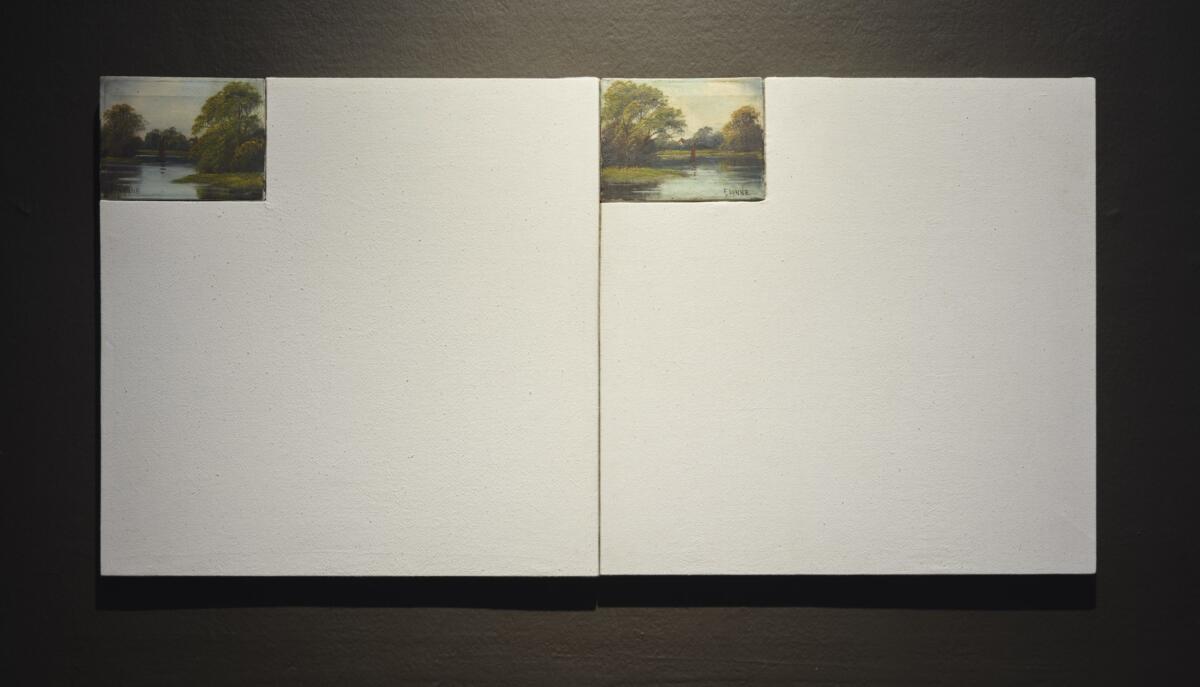
In Untitled (1976) the landscape painting is identified as not only ready-made because of its appropriation but posits the question of whether the medium of painting risks being ideologically ready-made. That the landscape, the still life, the portrait as prescribed actions of western easel painting, are put into relief when re-appropriated as inserts within the boundless possibilities of the ‘blank’ canvas but simultaneously questions the extent a blank canvas is already written with the lineage of its form.
Stephen McKenna, (1981)
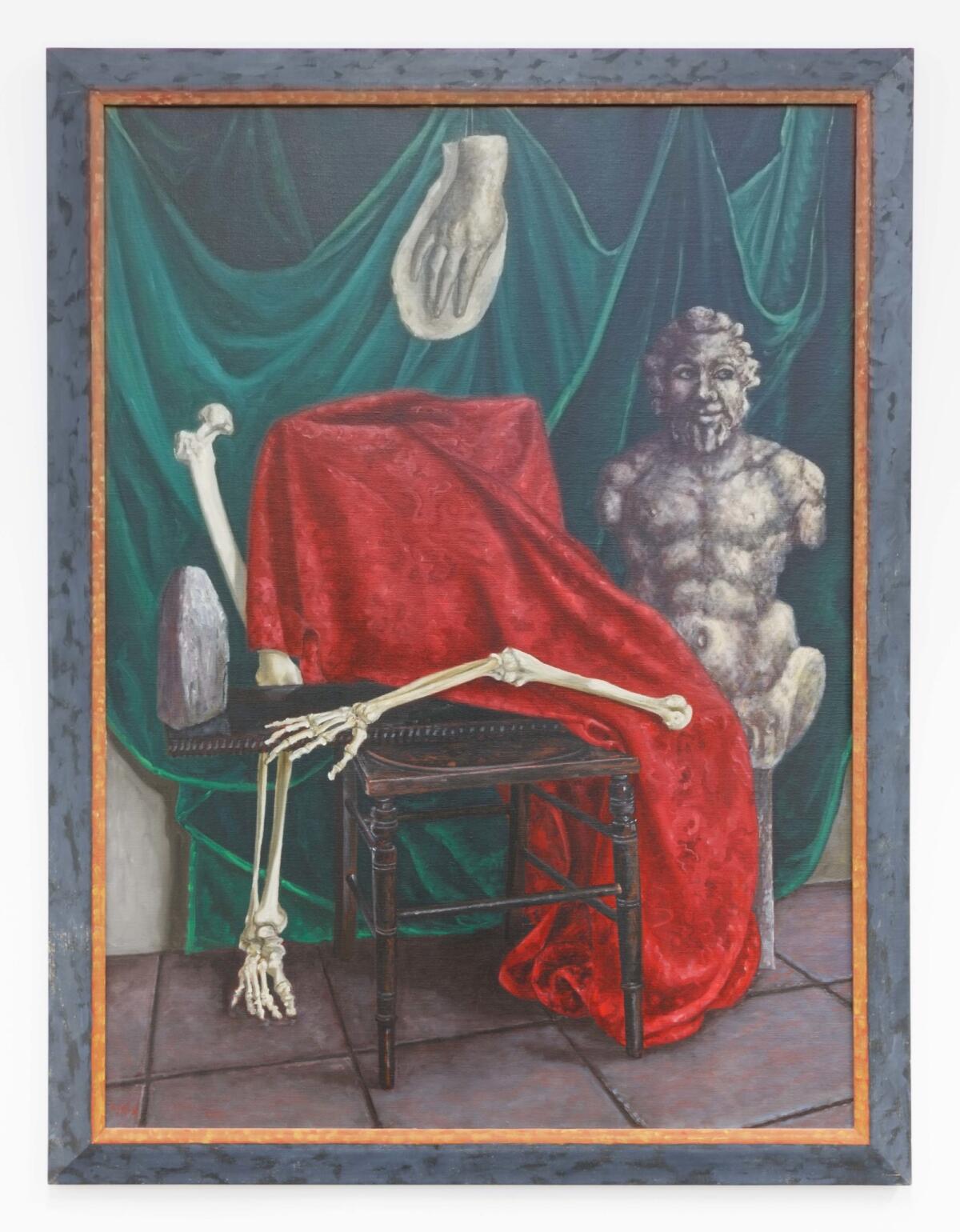
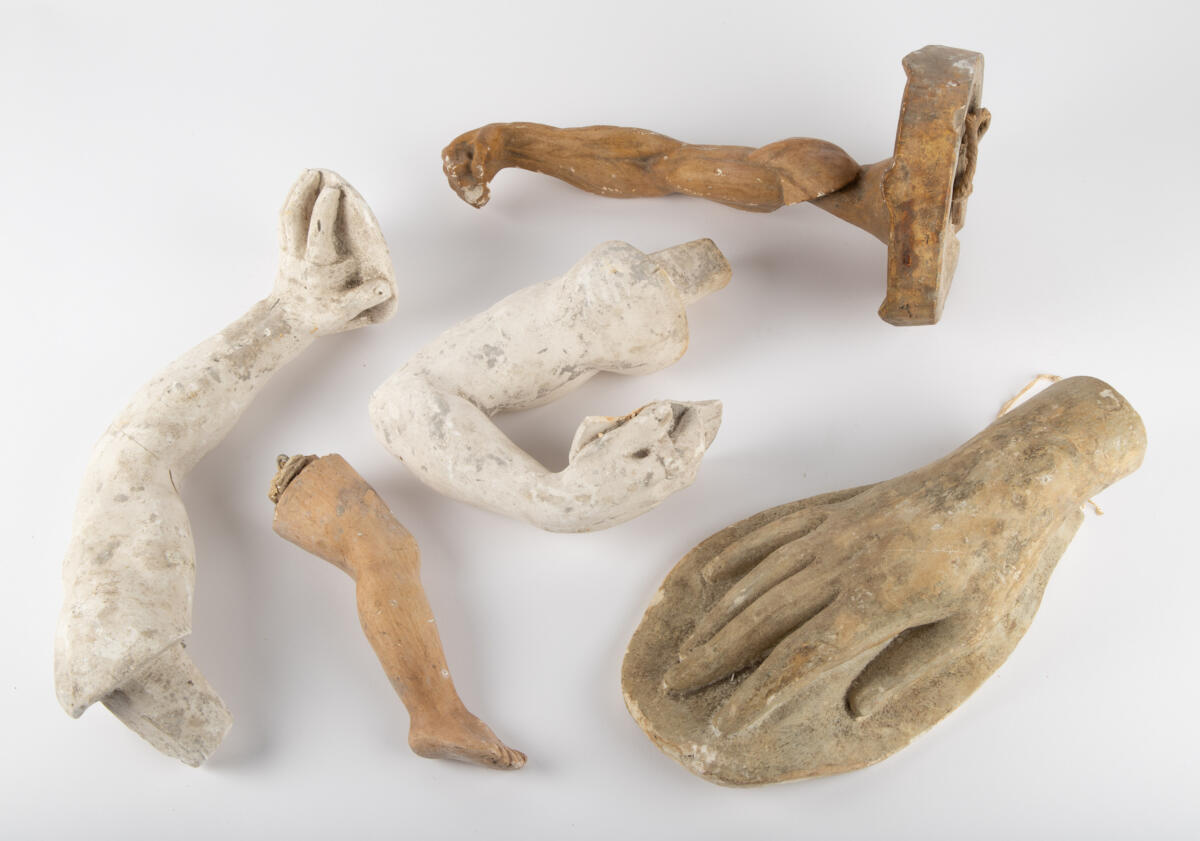
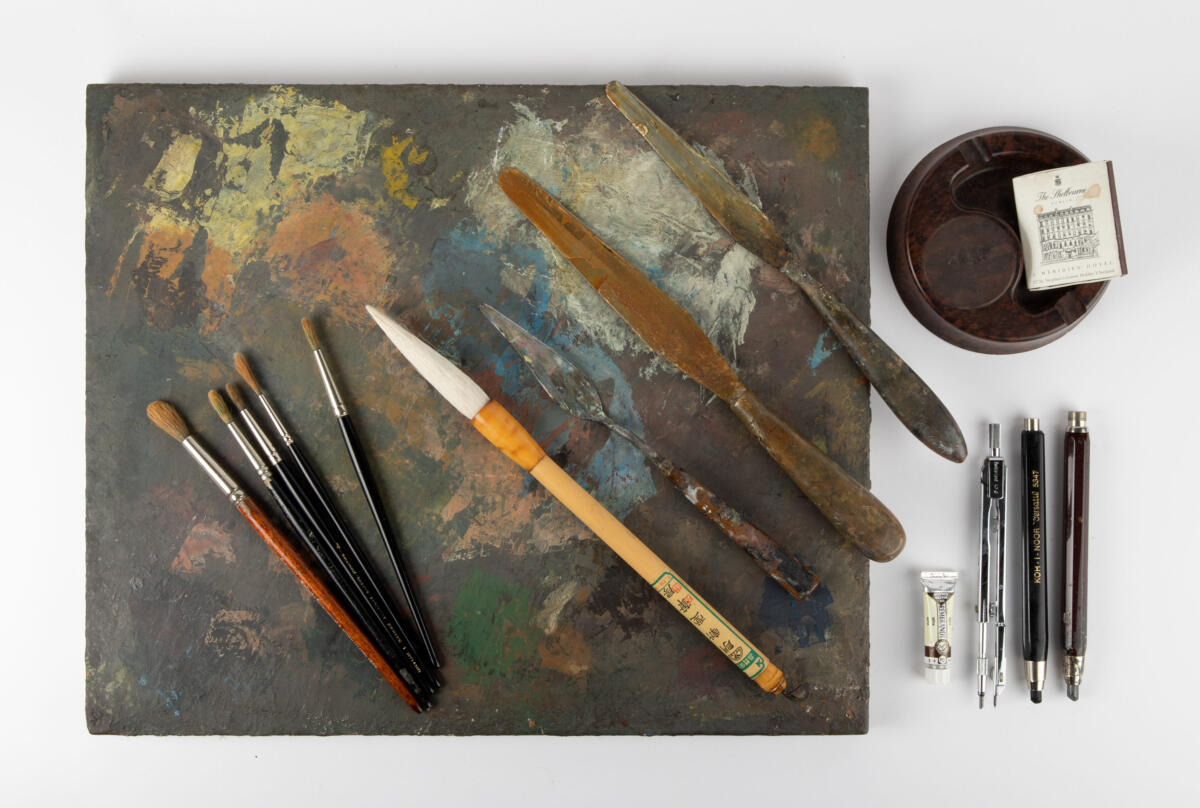
NIVAL has been home to the sketchbooks, press, diaries and studio objects of the late artist Stephen McKenna in its entirety since 2023. Meticulously wrapped and padded are an array of ephemera which have been immortalised in his own paintings. There are boxes of vases, jugs and teapots which have contributed to still life paintings such as Plans and Ashes, or delicately broken icons of Jesus. One archival box shows a crucified Jesus figurine appearing to slumber in his acid-free paper bedding, his now detached arms floating alongside him. Other items feature a disembodied arm, hand and leg, another representation of the crucifixion and one solitary wing, missing its angel. One plaster cast hand, with a gracefully pointed index finger, features in his 1985 painting, The Relics. The hand hovers above an arrangement of skeletal remains, stones and a frieze sculpture. The staging of this scene is complete with a green and red drapery. McKenna’s painting practice demonstrates a consistent exploration of the formal history of painting. From religious depictions, still life and landscape he saw the role of painting in the twentieth century as a representational pursuit that has lasted hundreds of years. In a review of Brian McAvera’s book Patrick Pye: Life and Work (2013), he writes:
“All paintings are a mixture of iconographical and the formal, with one of the two elements frequently dominating.” (McKenna, 2013, p. 2)
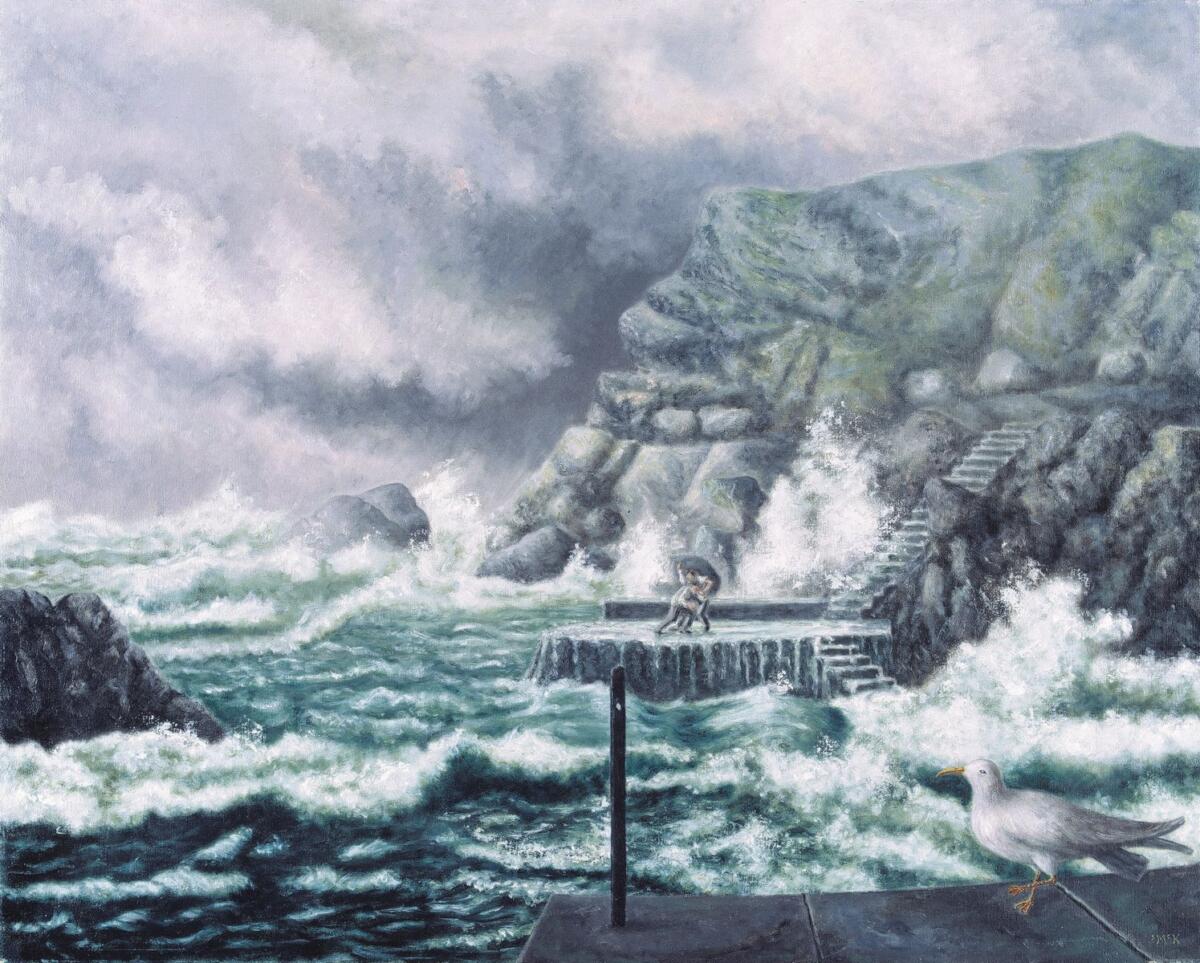
In McKenna’s own paintings his form of representation from still life to landscape seems to tether on these two elements, striking a fine balance that results in a suspension of resolve. Although his still life paintings depict the formal qualities of the genre, the objects are arranged dissonantly, as if performing the genre rather than embodying it. Similarly, his landscape paintings, such as The Irish Coast from 1981 are resistant to generating an awe-struck audience in the beauty of a wild Atlantic coastline. Instead, McKenna has constructed an image which invokes the heavy mist and sea spray of a stormy coast but maintains an evasive dissonance by including figures such as the isolated seagull in the foreground and the fighting figures in the distance, creating an image which Ian Jeffrey describes as McKenna’s ability to “invoke that capacity in language to create a meaning which can be gathered across the oeuvre as a whole.” (Jeffrey, 1993, p. 9) The Irish Coast’s colour palette and wild seawater is portrayed as ageless, it will outlive the figures who precariously battle in the midst of the stormy sea. The mortality of each figure is emphasised by fictional stairs added to the cliff side suggesting a “troubled ascent through physical dangers, and that idea of episodic progress …” (Jeffrey, 1993, p. 11), significant considering the year of this painting’s completion coinciding with the 1981 hunger strikes, when 10 men imprisoned in the H-Blocks would embark on gruelling hunger strikes in order to fight for political prisoner status.
The specificities of their struggle with the British state are not addressed, yet seems to be allegorised through the wrestling figures in the distance. The following year, McKenna would complete The City of Derry – The Foyle (1982), a cityscape depiction of Derry city with two figures in the foreground: one murdered man on his back surrounded by shrubbery and a mother breastfeeding. Although McKenna is depicting Derry city and the political violence it has suffered, the painting’s formulation is almost more indebted to Western art history than the scene directly represented. As David Fraser Jenkins writes:
“This was ten years after Bloody Sunday, and there is a British helicopter overhead. But the limits of the allegory are unclear …”. (Fraser Jenkins, 2015, p. 21)
In the 1984 essay ‘Postmodernism the Cultural Logic of Late Capitalism’ (which became part of the 1991 book of the same title), the philosopher Fredric Jameson provides a diagnostic framework of postmodernism not as an inevitable end point but rather as a cultural dominant. The aim of this analysis is to adequately identify what he describes as “a new depthlessness”. (Jameson, 1984, p. 57) Jameson defines this realm of veneers and culture of the image as resulting in a weakening of a sense of history in both the private and public realm. He defines what can be viewed as a cynical turn from historicity as resulting in a “new type of emotional ground tone” (Jameson, 1984, p. 57) where the paralysing spatial experience of late multinational capital operates similarly to the sublime of Romanticism. (Jameson, 1984)
Jameson develops this analysis of postmodernism further through his now famous comparison between Vincent van Gogh’s A Pair of Boots (1887) and Andy Warhol’s Diamond Dust Shoes (1980-81). His method focuses not on the stylistic elements of each artwork but positions them in a dialectical relation to one another defined by the periods in which they were created: van Gogh’s boots are considered as an artwork of high modernism and Warhol’s boots as post-modernism. Jameson’s analysis, informed by a Marxist historical materialism places these artworks not as merely emblems of genius or exceptionalism but situates them as a product of their respective periods. Jameson writes of van Gogh:
“I want to suggest that if this copiously reproduced image is not to sink to the level of sheer decoration, it requires us to reconstruct some initial situation out of which the finished work emerges. Unless that situation – which has vanished into the past – is somehow mentally restored, the painting will remain an inert object, a reified and product impossible to grasp as a symbolic act in its own right, as praxis and production.” (Jameson, 1984, p. 58)
Jameson’s methodology of diagnosing the cultural dominance of post-modernism, where pop culture, provocative images, high art, historical figures and events are flattened into a depthlessness of unmoving spectacle, is not purely designed to be relegated into art criticism. He states clearly that the superstructure of cultural expression is the surface of an ever-escalating and evolving military complexes under capitalism. Such analyses equip the viewer to not be blind to it.
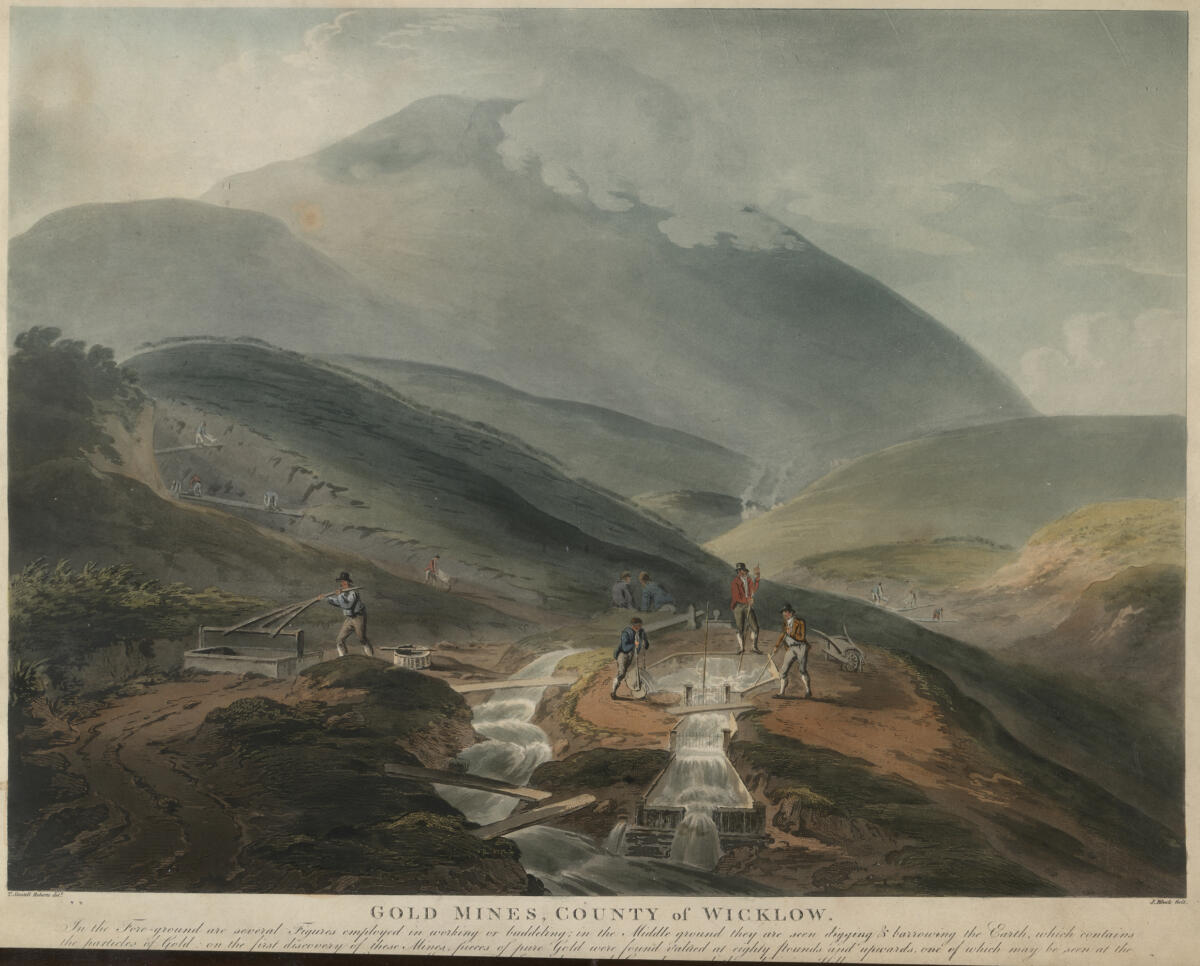
Considering Jameson’s methodology of cultural interpretation, paintings such as The Gold Mines in County Wicklow by Thomas Sautelle Roberts, where the construction of a military road or a gold mine is considered harmonious and correct within the landscape of the Wicklow mountains, further encapsulate and re-historise the Wicklow mountains as part of a new Romantic history. It is in these infrastructures, where a vast range of people across the economic scale may benefit from it to varying degrees, that there is an emphasis on how the individual may benefit from new industry brought to an area by a new road thus converting the Irish into an “economic subject” (Poovey, 1998, p. 136). Poovey continues that this “would encourage the Irish to see themselves as Petty saw them; and this perspective would enable them to realize that their true interest lay not in clinging to their Irishness but in embracing habits that would make them like the English.” (Poovey, 1998, p. 136)
In Untitled (1976) by Craig-Martin, Jameson’s diagnosis of postmodernity’s preoccupation with the realm of surface and artifice aligns with a nineteenth-century notion of picturesque theory. However, the difference lies in Jameson’s assertion of ‘waning of affect’. Whilst the gold mines of County Wicklow were designed to inspire a new economic Irish subject, Untitled (1976) by Craig-Martin is in a process of dismantling the institutionalised expectation of the modern painting, exemplifying a postmodern characteristic of authorless work where “they no longer simply ‘quote’, as a Joyce or a Mahler might have done, but incorporate into their very substance.” (Jameson, 1984, p. 55)
Although minimal in presentation it represents a flattening of sensibilities and taste that is equivalent to Pop Art. As Livingstone writes:
“The questions about authenticity, originality and invention proposed by these works … reinterpreted one of the basic themes of Pop in a manner that anticipated the fashion for appropriation in the following decade.” (Livingstone, 1990, p. 143)
In an Irish context, painting practices can be seen as bearing various historical loads, and although in McKenna’s paintings practices can formally generate harmony, they maintain a “disquieting” (Jeffrey, 1993, p. 15) effect: a maintenance of tension between the modern form of easel painting, standardised genres found in Western painting, and the historical weight of painting itself as an institution. The attempt to depict Ireland in the genre of landscape paintings, such as in The Irish Coast (1981) and The City of Derry – The Foyle (1982), are a nexus of conversations on the nature of painterly depiction and contemporary colonial violence and oppression. However, these conversations are more directed at the long history of painterly practice rather than the details of an Irish political reality. The violence depicted became part of a long lineage of depicting violence through painting, from Artemisia Gentileschi, Goya and Picasso. As Peter Geimer writes of Luc Tuyman’s paintings depictions of the Holocaust: “It sips at the real, at the atrocity of the gas chambers and the banality of evil, while at the same time managing to remain in the preservation of autonomous art.” (Geimer, 2012, p. 36)
Pronouncing Silence
“You speak in the dark. In the secret … Mother tongue is your refuge. It is being home. Being who you are. Truly. To speak makes you sad. Yearning. To utter each word is a privilege you risk by death.” (Cha, 2001, p. 45)
In the 1982 experimental novel Dictée, the artist Theresa Hak Kyung Cha recounts her mother’s experience of living under Japanese occupation in Korea. Banned from speaking her first language of Korean, Cha writes into her mother’s silence, into “the dark” (Cha, 2001, p.45). Dictée is an attempt to retrace Cha’s Korean genealogy, yet this pronunciation has been “fractured through the trauma of exile.” (Rinder, 2001, p. 18) Dictée makes the process of translation visible and audible as a cross-contamination of meaning that invites questions of how to decolonise the writing of a novel, but Cha obscures these expectations by building into the very flow of reading gaping holes of pause and stammer.
It is in works like Dictée where a monolingual speaker experiences the othering of their own tongue. It is not necessary to be a polyglot to access this realm of unfamiliarity. In fact, it is a method of allowing those whose first language has been violently imposed upon them from centuries of colonial expansion to make sense of being both reliant and discontent with your tongue. As Cathy Park Hong writes about Cha’s faltering use of periods: “Cha – who was actually fluent in French, English and Korean – made the immigrant’s discomfort with English into a possible form of expression.” (Park Hong, 2020, p.163)
Discussions on a variety of language revivals centre an experience of familial connection – or disconnection – as an ignition for learning a language that has been erased through colonial violence and occupation. In Ireland, one of the most evocative legacies of colonialism is the attempted erasure of the Irish language and the present dominance of English. Despite significant developments in the last century in providing educational resources in promoting the Irish language, the complex associations of shame, expectation and alienation subliminally imbued in language revival processes are sparsely acknowledged.
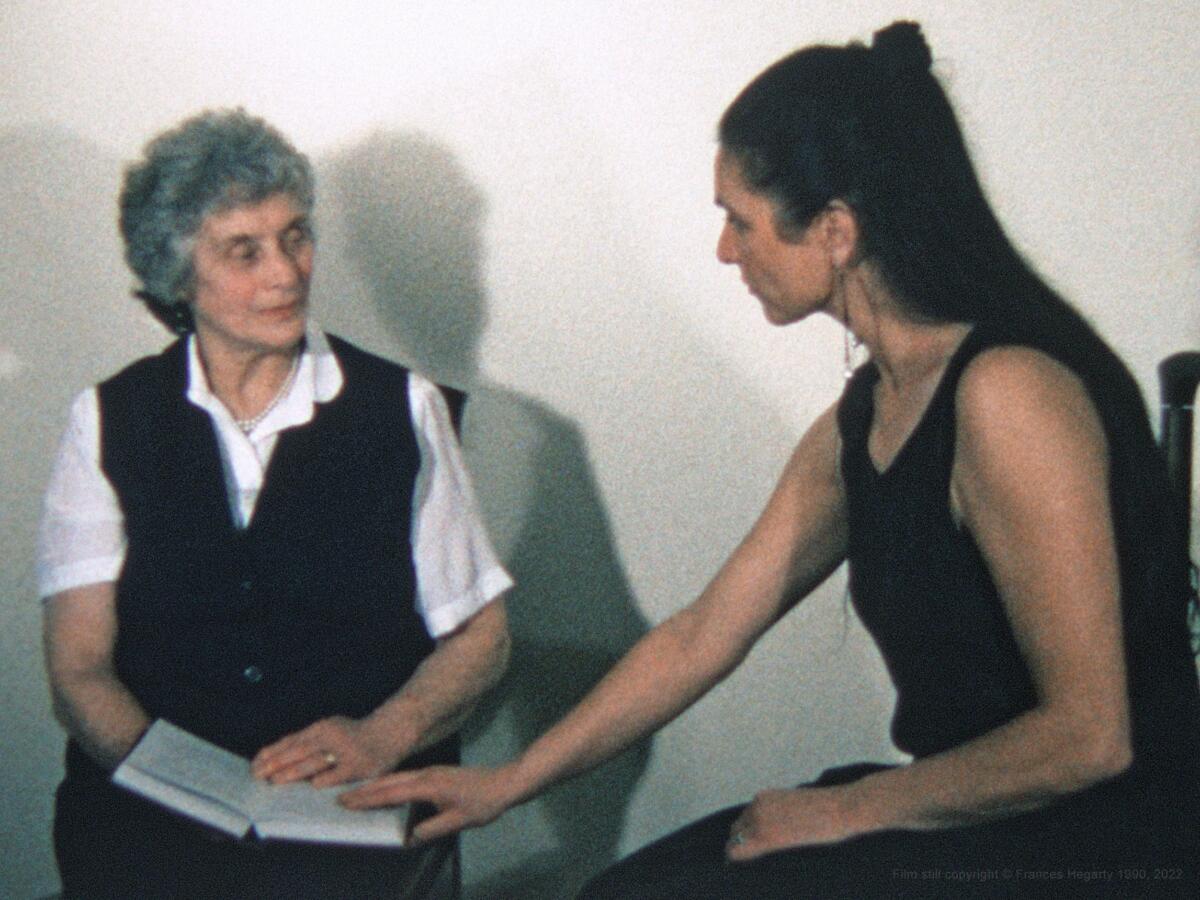
In the visual preservation room at IMMA, I sat next to their archivist and watched the 1995 short film Turas (Mother Tongue) by the Irish artist Frances Hegarty. The sound of rushing water surrounds the setting of a mother and daughter who sit opposite each other. This is the beginning of a series of departures, where the mother and daughter will reach out to one another – the mother touches the daughter’s mouth, a book is held and shared – before the daughter rises and turns away from her mother, walking out of the camera shot. The mother remains within the setting and as Monica Ross describes “we see her contemplate the process and anticipate its return. The substance of their encounter remains a linguistic enigma.” (Ross, 2004, p. 26)
Turas (Mother Tongue) is orientated around the question “an dtig leat cuidiú liom Gaeilge a labhairt arís? / Do you think you can help me speak Irish again?” The once first language of the artist has since been diminished due to both the need to immigrate and generational change. Her mother symbolises an opportunity to not only relearn Irish but a reconnection with an evasive desire that seems to only be articulated adequately through silence that is both an obstacle and a vehicle for this yearning to speak.
The appearance of ‘dh’ and ‘bh’ at the end and midpoint of words in Irish often function as a rounding-off of silence. Although their written appearance is explained as not being pronounced, a moulding occurs that spaces out this silence across the roof of the mouth. This distinction between pronouncing these silent letters as opposed to ignoring them completely is what accounts for the caving sounds that occur in Irish pronunciation. It is this relationship between the tip of the teeth and rolling sounds to the back of the throat that becomes a physically untranslatable experience. Untranslatable because you must inhabit these actions of the tongue in order to know them. The relationship between the sign of the word and its spoken form cannot be adequately mediated into conceptual knowledge.
Grasping at the simultaneous intimacy and cohabitation that occurs within the spoken word, it becomes imperative to consider the responsibility weighted within the stunted silences between languages. Recognising historical and current colonial power dynamics between languages is part of any resistance felt between the seamless transactional flow during the process of translation. This resistance is not felt as a push against something, but it is more like a negative magnetic force that simultaneously repels and absorbs both objects. Édouard Glissant identifies this double negative position as “forced poetics” (Glissant, 1989, p.121). It is in forced poetics that there is a centring of the colonial histories that have diminished or dominated particular aspects of a culture. Why might someone speak French and another an indigenous minor tongue that is on the verge of extinction. Creolization also recognises that embedded within this polyphony is always the deafening silence of cultural genocide. As Glissant writes “those shadowy threads of meaning where their silence is voiced” (Glissant, 1989, p.2).
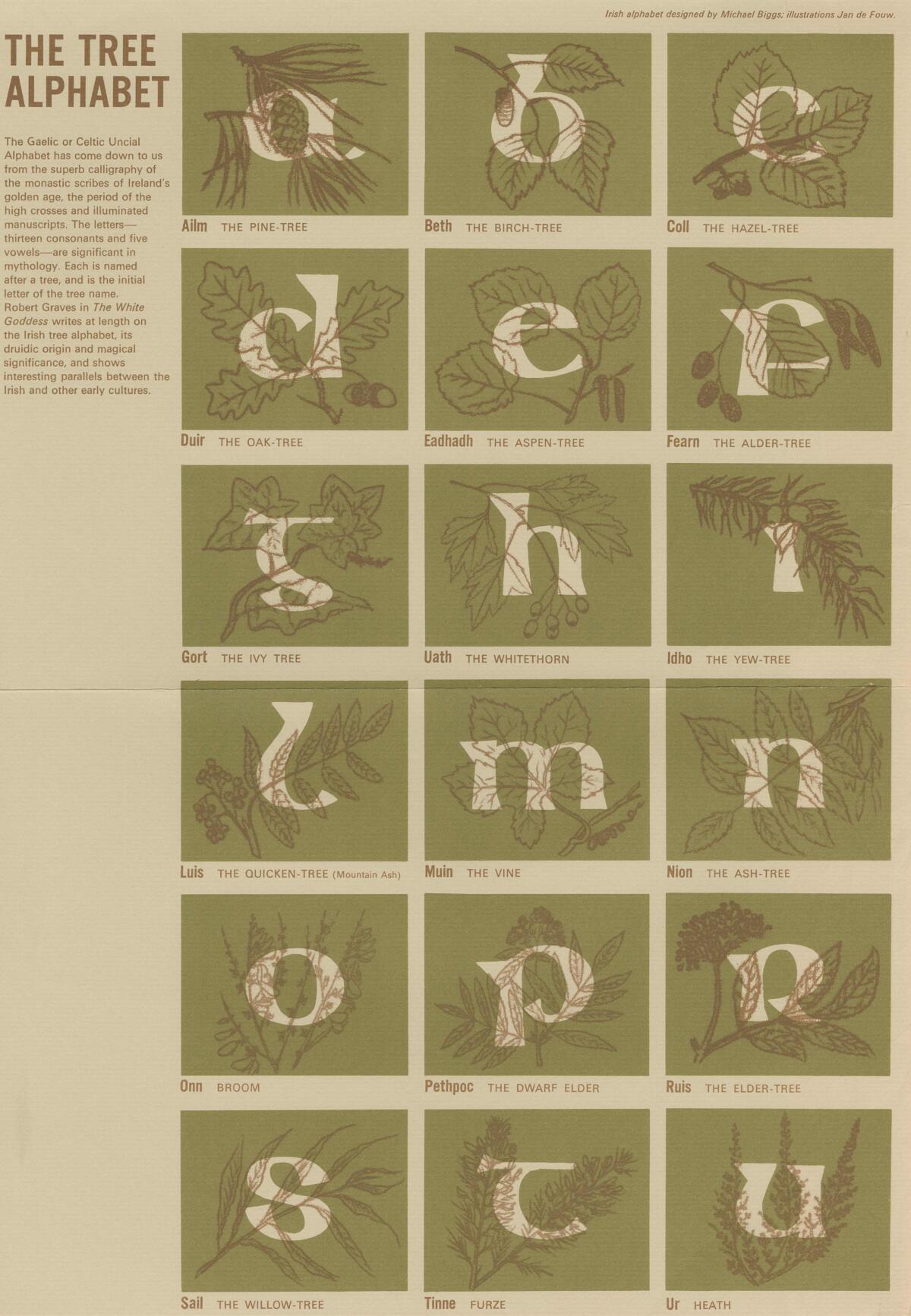
In Turas (Mother Tongue), the silence is washed away by the gushing River Foyle; a comforting constant as the soundscape of an endless journey or a simple white noise. A sonic abyss that evokes nature, but its sound can also be mistaken for a wash of static. Both perform a soundscape similar to Theresa Hak Kung Cha’s video work Mouth to Mouth (1975) where a mouth appears through the black and white snow of television static and sound to pronounce the vowels of the Korean alphabet. For both Turas (Mother Tongue) and Mouth to Mouth, the static of a river flowing or a television seem to act as sonic balm to the contradictory obstacles in the process of learning an expected first language in adulthood. The silence is pronounced in the archives of NIVAL. I view The Tree Alphabet, designed by Michael Biggs with illustrations by Jan de Fouw. The thirteen letters of the Gaelic Uncial alphabet are overlaid with the leaves of trees found in Ireland. In this poster, the long history of the Irish language is portrayed through its early origins in monastic print culture and a selection of indigenous and non-indigenous trees. The Irish language is imbued in associated with a perennial past. It is a constant through felling, it regrows, some never return. What feels perhaps like a safer position to learn from is through experiences of elemental, perceived essential forms to the language.
The Irish Language Movement throughout the nineteenth- and twentieth-centuries has grappled with the correct approach to preserve the language in native-speaking areas and to resurrect it elsewhere. The question of confronting the political colonial past has been disputed. As Ní Ghaibhí’s essay on the Irish context of Pádriag Mac Piarais graveside oration, the question of the Irish language’s political loyalties has historically been contentious. “Meanwhile, the much-loved head of the League, Douglas Hyde emphasised that as ‘long as the Gaelic League holds together’ the ‘pure light of the Irish language’ should ‘never, never’ be ‘trailed in the dust or in the mind of one faction or party or of politics at all.’ (Ní Ghairbhí, 2022) While the socialist republican James Connolly implored the Gaelic movement to centre the overthrow of British colonialism in their efforts in order to achieve true sovereignty over Irish culture, he writes: “I do not ask you to cease for a moment your endeavours on your present lines of education, but only to recognise in us your natural allies, as you should recognise that those who, under any pretext, however specious, would ask you to help them to perpetuate that British capitalism – which now thwarts you at every turn – is your enemy and the enemy of your cause.” (Connolly, 1898)
The Irish language has historically been violently uprooted as a native speaking language, from administrative violence that dispersed into familial dynamics. One measure taken to remove the generational transmission of Irish is the use of an bata scór or tally stick, a punitive measure to prevent children from speaking Irish: “Archbishop MacHale recounted wearing a tally-stick with the full consent of his non-English-speaking father, who was determined that his son should speak English at school and at home.” (Leyland, 1995, pp.47-92) Violence, political trauma and the genocide of An Górta Mór are the gaping abyss of colonial ruination which seep into the most intimate of silences. The shame and violence associated with the erasure and subsequent revival efforts seem a large abyss to try to abridge. It has been in artworks by Hegarty and Cha that the attempt to grasp the language is most successfully articulated because the yearning of it is centred, not just the knowing. As Benedict Anderson writes “Language is not an instrument of exclusion: in principle, anyone can learn any language. On the contrary, it is fundamentally inclusive, limited only by the fatality of Babel: no one lives long enough to learn all languages.” (Anderson, 2006, p. 134)
What needs to be accounted for is that languages made minor and vulnerable through colonial expansion are the chosen methods of survival. Have attempts to grasp the language evaded many because it has been encased in a vitrine of nineteenth-century antiquarianism? Methods which encase Irish culture in the structures of imperial museumification allude to Douglas de hÍde’s statement of not trailing a pure cultural emblem in the dust of the material reality of politics, despite its fundamental significance to the language’s attempted erasure. He might have benefitted from asking the question of where dust is most likely to settle? It is on static objects. The immovable. Although there is a desire to generate a future without vulnerability for minor languages and to forget the violence, it is in Dictée that Cha writes:
“‘Why resurrect it all now?’ to which she responds, ‘To extract each fragment by each fragment from the word from the image another word another image the reply that will not repeat history in oblivion.’ (Cha, 2001, p. 19)
Language revival efforts are not precisely about enacting practices oppressed by colonisation as pure cycles of repetition but also must speak to the ‘oblivion’ itself, which is not a simple silence, but is the forced poetics of Glissant or the artworks of Hegarty and Cha who reach through a historical occlusion, to visualise a desire to address and resist oblivion. If attempts such as these in art and design are not made, the Irish language, and any other oppressed language remains a yearning, a question of possibilities.
Irish Republicanism and the Past
“I am standing on the threshold of another trembling world. May God have mercy on my soul.”
– Bobby Sand’s diary, the 1st of March, 1981. Day one of his Hunger Strike.
In an essay titled “Dangerous memories and entangled temporalities: Irish republicanism and the postcolonial politics of time” (2023), the authors Farrell and Hussey outline what they describe as the “dangerous memory” of Irish republicanism in a post-1922 Anglo-Irish Treaty Ireland. The article outlines the battle for ownership over historical narratives, illuminating the contested Irish republican legacies in the twentieth century through the 1984 unveiling of the Roger Casement monument in Ballyheigue, County Kerry. The unveiling of the monument to Casement, who was executed in 1916 after a failed attempt to smuggle arms into Ireland in order to support the 1916 Easter Rising, took place at Ballyheigue: the site of the shipment’s failed landing, and of Casement’s capture by the British Navy. The unveiling of the monument came at a serendipitous time when only the previous day a vessel called the Marita Ann under the helm of the Irish Republican Army was intercepted by the Gardaí. Like Casement, the boat was attempting to deliver arms to the north of Ireland as part of an armed anti-colonial campaign. The uncanny timing of these two events put into relief a temporal disjointedness surrounding the history of Irish Republicanism. As Farrell and Hussey write:
“The political discourse and conservative commentary around the seizure of The Marita Ann evidenced a temporal as well as a spatial bracketing of the incident. Within such a scene of political contestation, the state’s discursive strategy sought to contain and domesticate the radical republican temporality as a desire which has already been realized, and equally articulate republicanism as a troublesome remainder of Irish history that has little relation to (post)colonial and anti-imperialist struggles elsewhere.” (Farrell and Hussey, 2023, p. 67)
The historical dissonance evidenced in this incident would be amplified further in state-run commemorative events of Irish republican activism, most notably the centenary of the 1916 Easter Rising, where the historical remembrance of an anti-colonial uprising was put in relief next to Ireland’s current political reality of remaining a colonised in the northern six counties.
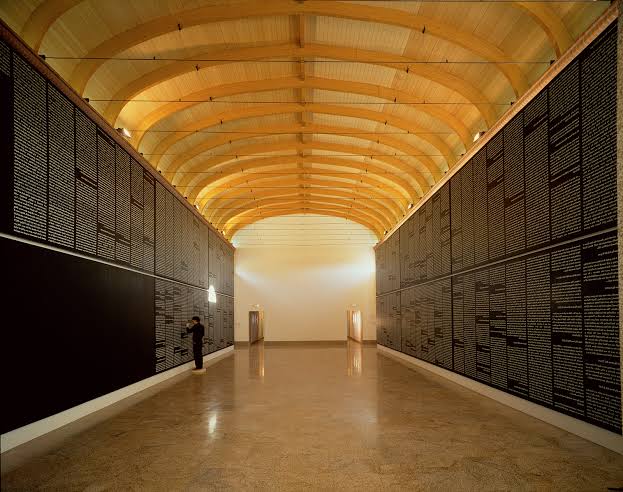
Although the remembrance of republicans of the early twentieth century has slowly become one of accepted heroic figures in Irish history, the activists of the mid-twentieth century, namely those of paramilitary groups such as the Irish Republican Army and the Irish National Liberation Army, do not share such statuses of remembrance. It is for this reason that in 1993, when an artwork titled Fragmens sur les Institutions Républicianes IV by the Irish artist Shane Cullen was first exhibited, that public discourse ignited such division on the nature of remembrance and monuments. The installation consists of 96 large panels. In meticulous, small writing in the Bodini font, Cullen and his assistant Jessica Callan transcribed the comms (prison communications) of Irish Republican prisoners incarcerated in the H-blocks during the 1980s. These comms were often written on cigarette papers, rolled up and smuggled in the body of a comrade in and out of the prison. Over the course of four years, Cullen would exhibit the piece as a work in progress, sometimes performing the transcription, such as in Belfast in 1994. The artwork generated much controversy when exhibited. In a 2013 article from the Irish Independent titled ‘Controversial Artwork Prompts Athlone Protest’, there is an account of the Luan Gallery, Athlone, facing local opposition to the work being exhibited. Protestors commented on the artwork as something that “glorifies terrorism”. Within art criticism, the hunger strikers were frequently analysed as short-sighted and naive idealists. With John Hutchinson describing their comms as “penetrating, self-revealing and brave, in another they were myopic, narcissistic, and self-justifying.” (Hutchinson, 1996)
When Brian O’Doherty adopted the persona of Patrick Ireland in response to Bloody Sunday in 1972, the mode of dress chosen for this character, as demonstrated in his work Five Identities (2022), is as a figure dressed in all-white with a sheer white nylon mask obscuring his face, the one item of clothing alluding to the balaclava worn by IRA activists at the time. However, the effect of the outfit projects an attempt to historically de-contextualise the anti-colonial political movement in Ireland into one, arguably myopic, self-justifying artwork. There cannot be a reference to a real, material anti-colonial organisation in the north of Ireland but instead a convenient figure of pure sentiment is created.


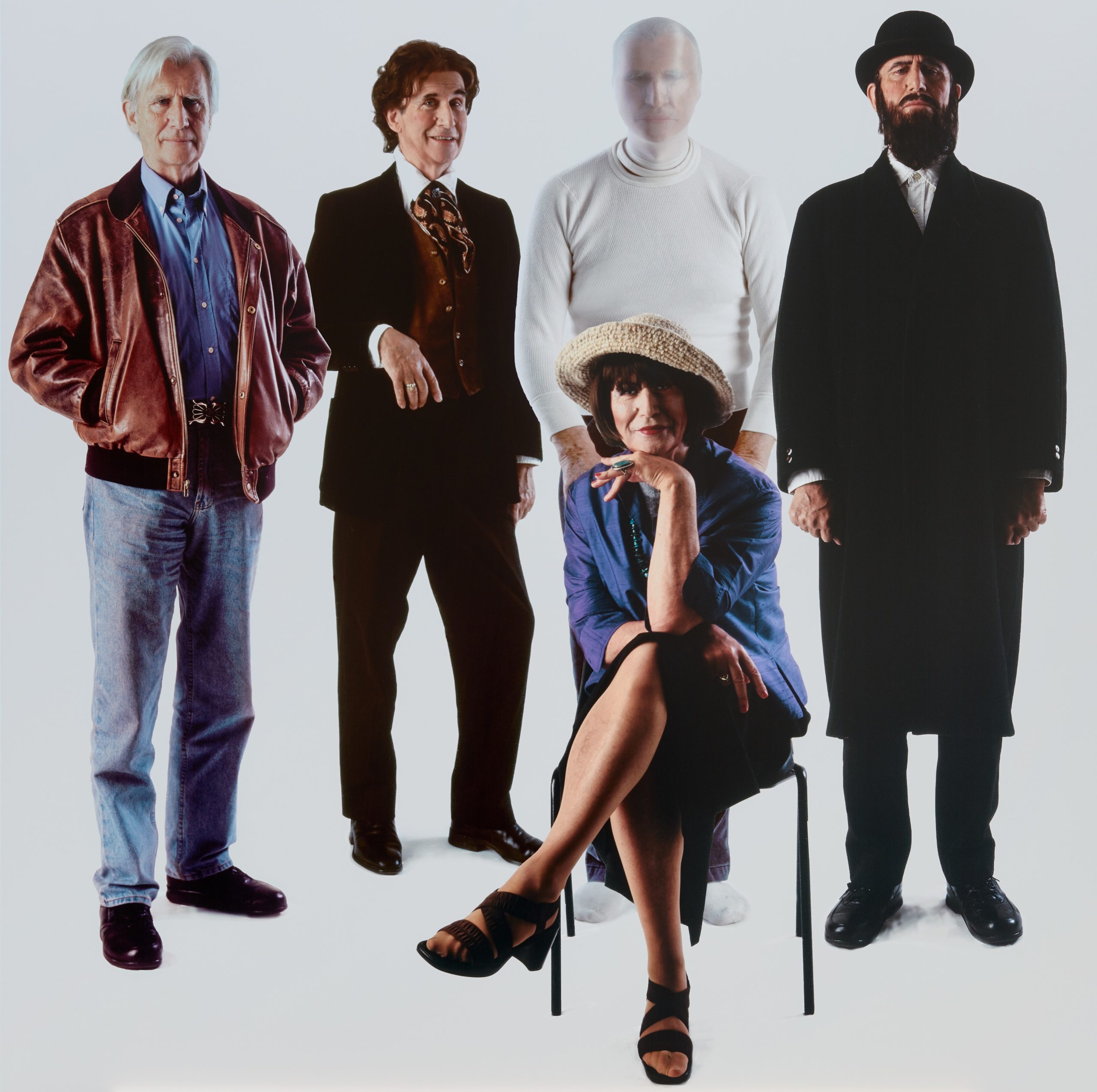
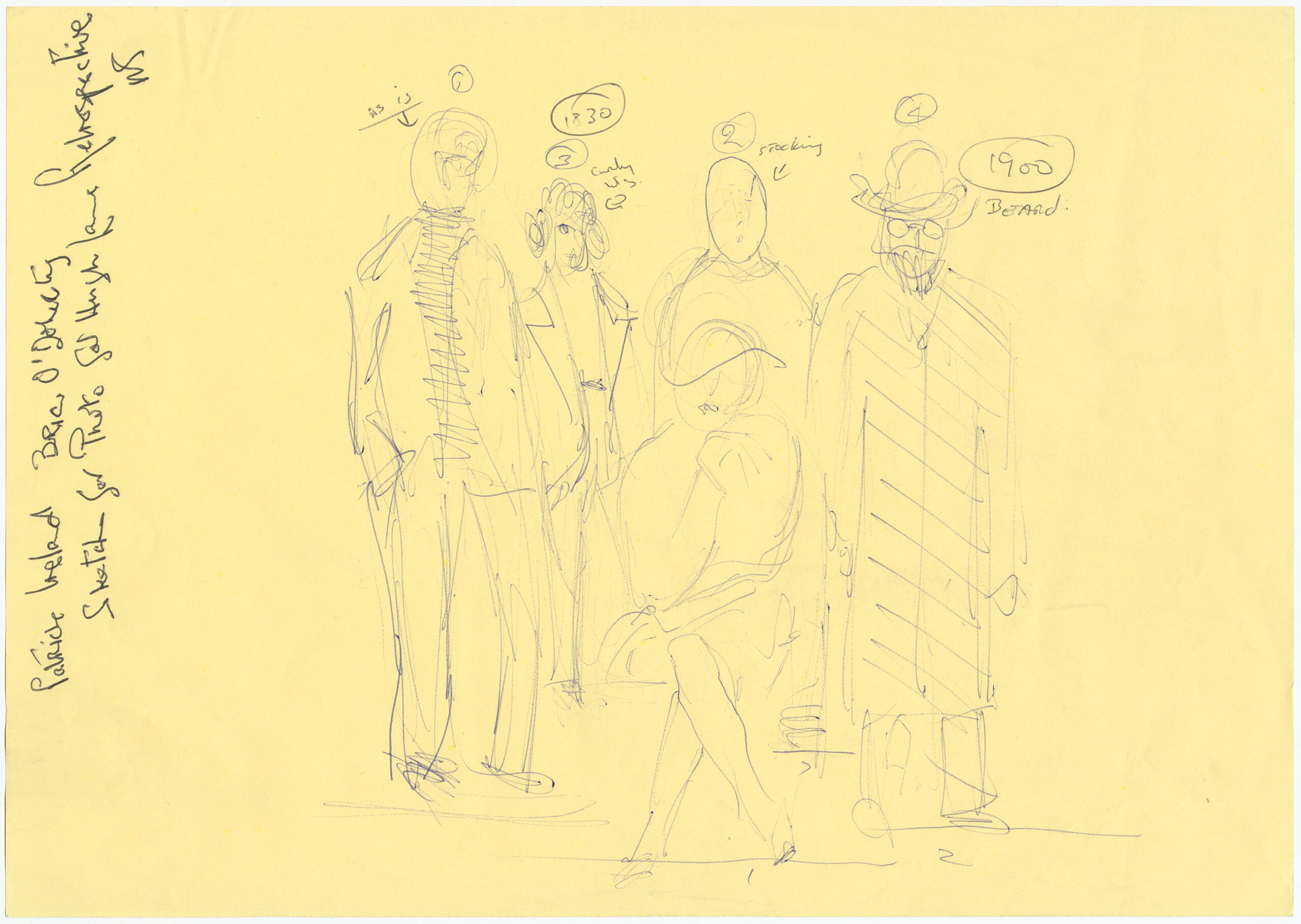
The erasure of resentment displayed towards these republican prisoners may be politically inflected, yet within academic discourse dominated by commitments to decolonial practice which frequently might encompass linguistic changes or a commitment to programming which reflects the colonial history of an institution, the role of armed anti-colonial resistance as part of a decolonial history across the world remains a deliberately evasive subject, and, as the figure of Patrick Ireland or Shane Cullen’s work demonstrate, can inspire much controversy if addressed at all. As Farrell and Hussey propose, it is the dangerous memory which disrupts the attempt to punctuate Irish history at an end point and, indeed, to finally become post-colonial: a term which has come to pre-emptively freeze the present in a state immune to the past which has created it and as a result inspire inaction to colonial legacies. As Anne McClintock writes: “The ‘post-colonial scene’ occurs in an entranced suspension of history, as if the definitive historical events have preceded us, and are not now in the making.” (McClintock, 1994, p.255)
Although the artist Shane Cullen vehemently denied any political affinity with the hunger strikers, or any political party for that matter, Fragmens sur les Institutions Républicianes IV has nonetheless through the medium of conceptual art memorialised the poetry, sentiments, and organising-between-members of an organisation that had connections with a myriad of anti-colonial military campaigns across the world. Despite Cullen’s own political convictions, his artwork raises the question of the nature of monuments. The strong reaction to the work seemed fitting in its status as a formal challenge to the creation of monuments, and consequently where is the consensus found in Ireland’s colonial past? As outlined by Farrell and Hussey, the monumentalising form given to what were originally clandestine communications, ingeniously smuggled alongside essential provisions such as radios, tobacco, and reading material positions the history of modern Irish Republican activists as historical figures on par with monumentalised Casement, Pearse, or Wolfe Tone. As Wilson wrote in the exhibition’s accompanying publication:
“This work, this monument which is more a representation of a monument than a monument proper, is marked by the trace of a particular body, the body of the painter. It is further marked by absent bodies, bodies reduced, erased and superseded by text. It is marked by their words, the words of dead men negotiating the terms and conditions of their death.” (Wilson, 1997, p. 19)
In the contextualising stories surrounding the content that makes Fragmens sur les Institutions Républicianes IV a historically indebted work that it is, is overwhelmingly the story of the colonised body. As Bobby Sands wrote in his diary on the first day of his hunger strike, his commitment to national liberation through armed struggle is what now leaves him “…i ncarcerated, naked and tortured.” (Sands, 1981) Additionally the comms were smuggled within the body, to such extremes that Bobby Sands’ cell-mate Malachy Carey was referred to as ‘The Suitcase’ due to his ability to smuggle such volumes of objects in one trip. The preceding no-wash protests demonstrated this further where faecal matter and menstrual blood were smeared across the prison cell walls. For the body of the colonised subject, the abjection of the body while incarcerated are the remaining means of resistance.
The physical duress and limitations of the body are enacted within Mairéad McClean’s 2014 video work No More. As the artist writes in a description of the work, it attempts to account for “the disconnect between control of the body and lack of control over the external forces that surround it.” (McClean, 2014)
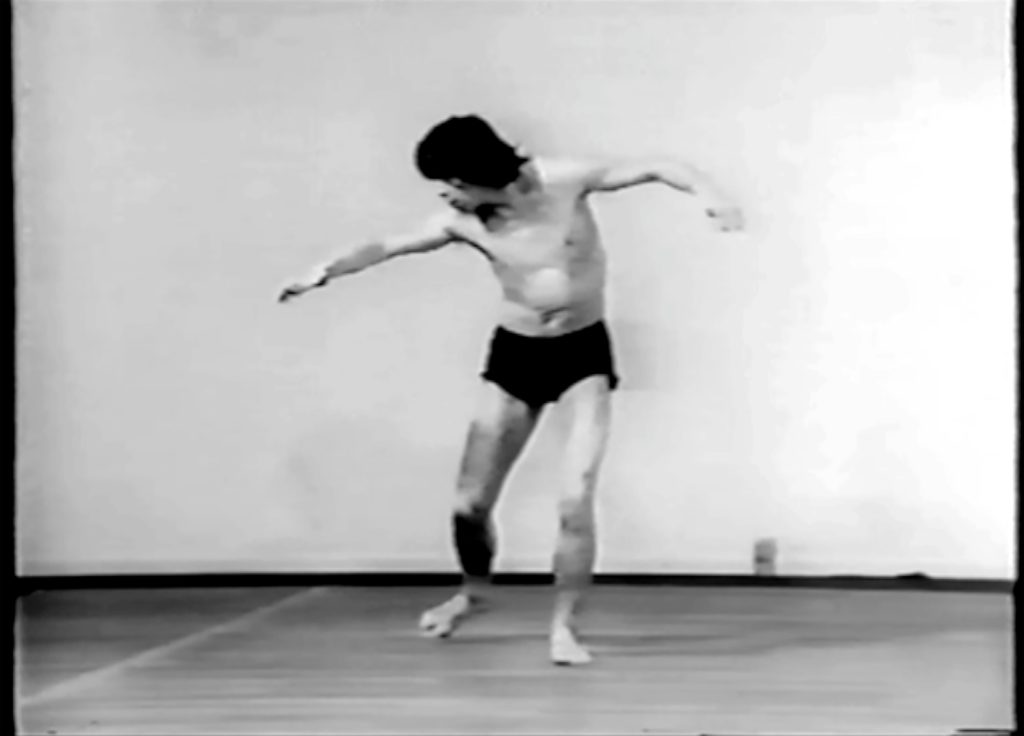
No More by McClean addresses the kidnapping and forced distances between families by colonial occupational forces through the introduction of internment in the north of Ireland in the 1970s. The work situates archival media footage alongside sounds and imagery of the artist’s own memory of that time period when her father along with almost 2000 people, mostly Irish Catholics and nationalists, were interned without trial. Most were not active in paramilitary groups, however the introduction of internment would galvanise a generation who witnessed their family members dragged from their homes and imprisoned.
A black and white shot of an arm seizing its wrist to a beat opens the videowork. Sounds of static, radio transmissions and sirens punctuate the constant beat. The arm seizes and relaxes again and again. A stern voice of a male says the words ‘I have taken this serious step.” The seizing arm belongs to a man with shaggy, shoulder length hair and dressed in nothing but shorts or moving in a sudden, stilted manner. When still, his muscles are tense and ready to react once more. The video is taken from a 1972 Jerzy Grotowski’s Polish Laboratory Theater training film, where the Polish actor Ryszard Cieślak performs to the sound of a bell tolling, telephone connections, and news reports that generate a soundscape of a time period when the artist’s father inexplicably disappeared. A flash of a letter written by the artist when she was five years old to her imprisoned father fills the screen:
‘Pleas Daddy will you ask the government when will you get home?’
In Henry McDonald’s article on McClean, the artist has spoken about No More (2014) as an attempt to account for a child’s memory of these traumatic events. (McDonald, 2014) The completely different context of Cieślak movements are aligned in time but also in the evocative figure of a long haired young man, almost completely naked, enacting a series of movements to push the body to its limitations. It is hard not to be reminded of the evocative imagery of the Blanket Men or the hunger strikers. As republican prisoners embarked on blanket protests, no-wash protests and finally hunger strikes to fight for their political status in prisons, as soldiers at war, rather than regular criminals.
The status of the colonised is always to be othered and criminal to an occupational power. As the author David P. Nally writes in his book Human Encumbrances: Political Violence and the Great Irish Famine, the view of the Irish population as uncivilised and barbaric by British occupational administration has resulted in a paternalistic development of colonial violence where “the expansion of biopolitical norms, enabled the colonial state to target the Irish social body under the pretext of reform.” (Nally, 2011, p. 18) It is in the even tones of Brian Faulker’s 1971 announcement of the introduction of internment, that he quietly states “it is with understandable reluctance” a slight twist in his mouth as he continues “that one uses these exceptional powers.” (AP Archive, 2018)
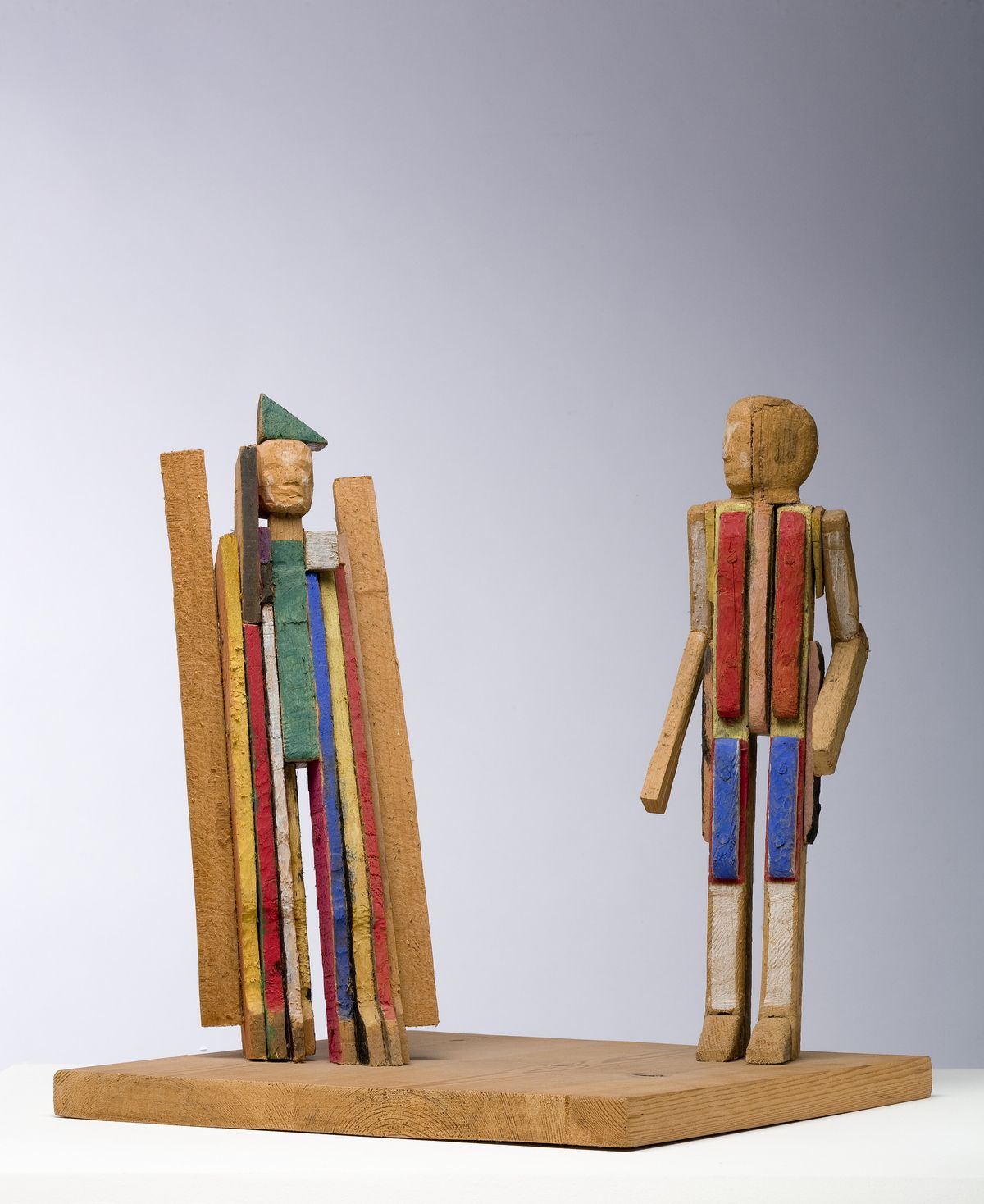
Despite the desire to relegate Ireland’s protracted colonial condition to a finite history, the desire for a different future, of an Ireland completely uncolonised, remains a goal of many active republican organisations in Ireland. In an artwork such as A Funny Thing Happened on the Way to the G.P.O. (1990) by the sculptor James McKenna, a viewer may be asked to forgo the obvious connotations such a title might evoke for the average person who has an awareness of Irish history.
The work depicts two figures seemingly encountering each other by surprise as they pass each other. One figure has a red triangular cap perched on his head, potentially depicting them in uniform. What purpose does it serve today to resist or embrace the historical contexts this work may or may not be invoking? Today, many of significant sites of the 1916 Easter Rising such as Moore Street and the G.P.O are under threat of being redeveloped into the ever-increasing, faceless facades of luxury hotels and shopping centres. If the remains of one of the most defining points in Irish history are not considered as educational sites of historical engagement, the ongoing development of Dublin into an economically viable yet alienated city to its residents will continue to compact the past. Yet as Walter Benjamin writes of historical materialism: “In this structure he cognizes the sign of a messianic zero-hour [Stillstellung] of events, or put differently, a revolutionary chance in the struggle for the suppressed past. He perceives it, in order to explode a specific epoch out of the homogenous course of history; thus exploding a specific life out of the epoch, or a specific work out of the life-work.” (Benjamin, 2005) It must be asked what is the danger of fully perceiving Ireland’s past? The work Fragments Sur la Republicaines IV perhaps gave a perception into recent Irish history that raises uncomfortable questions on the lengths of decolonial practice. When Bobby Sands writes on the first day of hunger strike that he is on the “threshold of another trembling world”, he not only speaks of death but embodies this revolutionary chance in the struggle for the suppressed past.” (Benjamin, 2005) The fear to allow the history of the hunger strikes to speak now, whether through contemporary art or traditional commemoration, speaks to a past that remains a trembling on a threshold.
A Present Soundscape
Although the primary outcome of this L’internationale Research Residency has been to create a research guide, I additionally proposed to create a soundscape to accompany the text. A Present Soundscape is an intuitive collective of the sounds which have been the backdrop of this research residency. From informative conversations, the car engine I travelled in, to the helicopters which have dominated the skies of Dublin as one of many security measures during the EU presidency and the controversial visit of President Donald J. Trump. The length of the soundscape is 25 minutes long, a rough estimate of the walking time between the National Irish Visual Arts Library and the Irish Museum of Modern Art.
Tracklist
- Audio of commute through the Military Road in the Wicklow Mountains
- Let this moment linger – Aisling Ní Aodha
- Conversation with Rónán Ó Raghallaigh in NIVAL
- Protest soundscape – Aisling Ní Aodha
- Fríd Lár – Vocals by Aisling Ní Aodha, produced by _entrd
- A reading from p. 184 of Anderson, B.R.O’G. (2006) Imagined communities: reflections on the origin and spread of nationalism. Rev. ed. London: Verso.
- An interview with Barry Keogh on the grounds of IMMA
- A reading from p. 57 of Jameson, F. (1984) “Postmodernism, or The Cultural Logic of Late Capitalism,” New Left Review, 1(146), pp. 53–92.
- An interview with Alessia Cargnelli in the Edward Murphy Library’s group space
- The March of Brian Boru – performed by Aisling Ní Aodha
Access
NIVAL
NIVAL prides itself on providing maximum accessibility to the public. Access is provided by appointment only. You can view items in NIVAL’s collection through the online catalogue.
You can find out more about facilities that are available to visitors in our Access Statement, which includes information on public transport links, bathroom locations, wifi information and more.
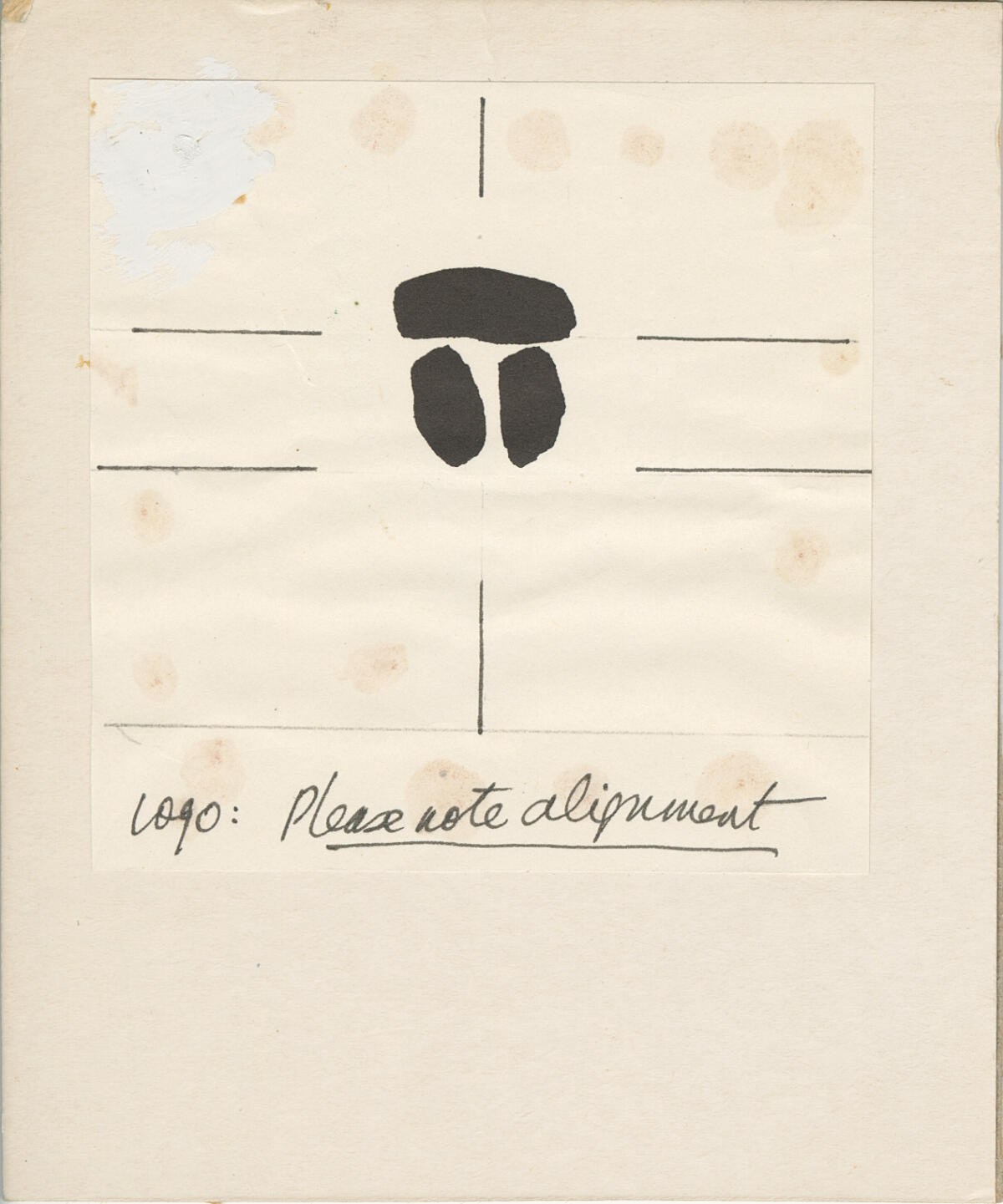
IMMA

IMMA’s accessiblity policy may be found on their website. IMMA’s team may be contacted via their website form.
Acknowledgements and Access
This research residency was funded by L’Internationale, a European confederation of museums, arts organizations and universities founded in 2009. It takes its name from the nineteenth-century workers’ anthem written by Eugène Pottier.
The research for this residency would not have been possible if not for the support and guidance from the staff at the NIVAL and IMMA. I would like to thank the whole team at NIVAL, with special thanks to Donna Romano, Ruth Hallinan and Rónán Ó Raghallaigh for their engaging conversations that led me to exciting new avenues. I would like to thank Clare Lymer in NIVAL for her technical support in digitising items referenced in this guide. Special thanks to Johanne Mullen, Sonia Milewska and Barry Kehoe at IMMA for providing exclusive access to areas of IMMA and its history. Thank you to my interviewees Rónán, Barry and Alessia Cargnelli for kindly allowing me to include our conversations in the final sound piece. Thank you to the Edward Murphy Library for providing a wide array of academic sources and a tranquil space to formulate ideas.
I would finally like to thank my peers and comrades who assisted with reading over the various drafts of these texts. I am indebted to them for being endowed with hope for the future. May we reach it together.
Introduction
- Anderson, B.R.O’G. (2006) Imagined communities: reflections on the origin and spread of nationalism. Rev. ed. London: Verso.
- Beckett, S. (1974) Mercier and Camier. London: Calder & Boyars.
- Carse, A. (2017) ‘Keyword: infrastructure: How a humble French engineering term shaped the modern world’ in Harvey, P, Bruun Jensen, C, and Morita, A. (eds.) Instrastrcutures and Social Complexity: A Companion. Routeldge: London.
- Clare, D. (2016). ‘Turns wick low’: Samuel Beckett’s Darkening Vision and an Irish County. Studies: An Irish Quarterly Review, 105 (420), 497-509. Retrieved July 12, 2021.
- Cullen, F. (ed.) (2023) Ireland and the British empire: essays on art and visuality. Oxford: Peter Lang.
- Higgie, J. (2008) The Burial of Patrick Ireland (1972–2008). [online] Frieze. Accessed 28 July 2026.
- Jameson, F. (1984) “Postmodernism, or The Cultural Logic of Late Capitalism,” New Left Review, 1(146), pp. 53–92.
- Mattern, S.(2013) “Infrastructural Tourism,” Places Journal. Accessed 27 Jul 2021.
- McVeigh, R. and Rolston, B. (2021) Ireland, colonialism, and the unfinished revolution. Chicago, IL: Haymarket Books.
- Moran, L. (2020). Statue Wars. [online] IMMA. Accessed 5 Sept. 2026.
- Wright, G.N. (1822) A Guide to the County of Wicklow: Illustrated by Engravings, After the Designs of George Petrie, Esq., and a Large Map of the County, from an Original Survey. London: Printed for Baldwin, Cradock, and Joy.
Let This Moment Linger: The Promise of 1916
- Anderson, B.R.O’G. (2006) Imagined communities: reflections on the origin and spread of nationalism. Rev. ed. London: Verso.
- Atkin, L., Garvey, N., Fermanis, P., & Comyn, S. (2019). Early Public Libraries and Colonial Citizenship in the British Southern Hemisphere. Springer.
- Bowe, N.G. (2024) Visualizing the Celtic revival: the arts and crafts movement in Ireland. Edited by R. Kennedy. Dublin: Four Courts Press.
- Chenevix Trench, F.G. and Pyle, H. (2005) Cesca’s diary, 1913-1916: where art and nationalism meet. Dublin: Woodfield Press.
- The Language Movement. Accessed 4 September 2026.
- Dupont, C., & Gifford, G. (2018). ‘ART Collections: STRENGTH OF DRAGONS’. Irish Arts Review (2002-), 35(3), 58–58. Accessed 22 September 2026.
- Grey, J. (2023, April 17). Imperially_structuring_global. warwick.ac.uk. Accessed 25 June 2026.
- History Ireland, 21(4), 8–9. Accessed 24th October 2026.
- Murphy, R. 2008) Ella Young, Irish Mystic and Rebel: From Literary Dublin to the American West. Dublin: The Liffey Press.
- Nordic Irish Studies, 12, 79–94. Accessed 22 January 2026.
- Grace Gifford Plunkett and Irish freedom: tragic bride of 1916. Dublin: Irish Academic Press.
- Irish Arts Review (2002-), 31(2), pp. 114–117.
The Landscape, Picturing Painting and the Picturesque
- Cooke, L. (1989) ‘The Prevarication of Meaning’ in Craig-Martin, M. and Whitechapel Art Gallery (1989) Michael Craig-Martin: a retrospective, 1968-1989. London: Whitechapel.
- Graw, I. (2018) The love of painting: genealogy of a success medium. Edited by N. Dunphy. Translated by B. Hanrahan and G. Jackson. Berlin: Sternberg Press.
- Geimer, P. (2012) ‘Painting and Atrocity: The Tuymans Strategy’ in Graw, I. et al. (2012) Thinking through painting: reflexivity and agency beyond the canvas. Berlin: Sternberg Press.
- Jameson, F. (1984) ‘Postmodernism, or the cultural logic of late capitalism’, New Left Review (146), pp. 53–92. Accessed 7 August 2026.
- Livingstone, M. (1990). Michael Craig-Martin. London, Whitechapel Art Gallery. The Burlington Magazine, 132(1043), 142–143.
- McKenna, S., Dawson, B. and Jenkins, D.F. (2015) Stephen McKenna: Perspectives of Europe 1980–2014. Middlesbrough and Dublin: Middlesbrough Institute of Modern Art & Dublin City Gallery The Hugh Lane.
- McKenna, S. and Irish Museum of Modern Art (Kilmainham, Dublin, Ireland) (1993) Stephen McKenna: paintings 1985-1993. Dublin: Irish Museum of Modern Art.
Pronouncing Silence
- Anderson, B.R.O’G. (2006) Imagined communities: reflections on the origin and spread of nationalism. Rev. ed. London: Verso.
- Cha, T.H.K. (1982) Dictée. First California paperback edition. Berkeley: University of California Press.
- Connolly, J., 1898. The Language Movement. Accessed 4 September 2026.
- Minor Feelings: An Asian American Reckoning. New York: One World.
- Glissant, É. (1989) Caribbean Discourse: Selected Essays. Translated by J. Michael Dash. Charlottesville: University Press of Virginia.
- Lewallen, C., Rinder, L. and Trinh, T.M.-H. (2001) The dream of the audience: Theresa Hak Kyung Cha (1951-1982). Berkeley: University of California Berkeley Art Museum.
- Leyland, J.(1995) ‘Outposts of the Gael: The Decline of Gaelic in the Great Blaskets and St Kilda’ in Kockel, U. (ed.) (1995) Landscape, heritage and identity: case studies in Irish ethnography. University of Liverpool Institute of Irish Studies Liverpool: Liverpool University Press.
- Ní Ghairbhí (2022) “Is ní cheilim, deirim, déarfad: the O’Donovan Rossa funeral, Pearse’s graveside oration and the Irish language context,” Irish Studies Review, 30(4), pp. 476–497.
- Ross, M. (2004) ‘Beyond Partition’ in Hegarty, F. (2004) Frances Hegarty: selected works 1970-2004. Oysterhaven, Ireland: Gandon Editions.
Irish Republicanism and the Past in Visual Art
- AP Archive (2018). News Item (680be254-8a91-d02a-7366-04d2d01e4eb8). Youtube. Accessed 6 July 2026.
- Benjamin, W. (2005). On the Concept of History. [online] Marxists.org. Accessed 1 Sept. 2026.
- Wilson, M. (1997) ‘Fragments and Responses’ in Cullen, S. et al. (1997) Shane Cullen: fragmens sur les institutions republicaines IV. Derry, Vassiviere en Limousin: Orchard Gallery: Centre d’art contemporain.
- Farrell, L. and Hussey, G. (2026) ‘Dangerous memories and entangled temporalities: Irish republicanism and the postcolonial politics of time’, Cultural Studies, 40(1), pp. 59–81. doi: 10.1080/09502386.2024.2414054.
- Hutchinson, J. (1996) Better than the Brown Earth … (On Shane Cullen’s ‘Fragmens sur les Institutions Republicaines IV’). Dublin: The Douglas Hyde Gallery.
- McClintock, A. (1994) ‘The Angel of Progress: Pitfalls of the Term ‘Post-colonialism’ in Barker, F., Hulme, P. and Iversen, M. (1994) Colonial discourse, postcolonial theory. Manchester [England], New York: Manchester University Press; Distributed exclusively in the USA and Canada by St. Martin’s Press.
- McDonald, H. (2014). “Daughter of one of Northern Ireland’s ‘hooded men’ wins MAC arts prize”. [online] The Guardian. Accessed 5 Sept. 2026.
- Nally, D.P. (2011) Human encumbrances: political violence and the Great Irish Famine. Notre Dame, Ind.: University of Notre Dame Press.
- Sands, B. (2019). Prison Diary, Bobby Sands Trust. [online] Bobbysandstrust.com. Accessed 5 Sept. 2026.